“You’re Only As Good As Your Last Piece”, ‘The War Of Art’ and The University of Derby
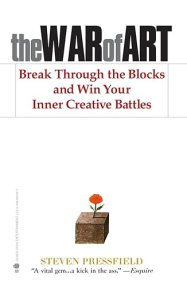
My therapist recommended a book to me once, ‘The War Of Art’ by Steven Pressfield. When I was listening to the audiobook, I messaged a friend about it, explaining my thoughts about the book’s message. Despite the fact that the book pre-dates the normalisation of discussing chronic health conditions and mental illness, the crux of the book resonated with me and the lessons I was taught during my Undergrad at The University of Derby.
In response, she said, “Wow, when I was doing my course, we were told we were only as good as our last piece”.
I was appalled.
I said as much, and then she asked me whether I was taught with similar principles.
In short, absolutely not.
While one can argue that this bleak method of teaching was done to sardonically remind a cohort of students the sheer enormity of the industry they were entering, there are better ways to teach an impressionable mind. I am not a teacher, but I was raised by one, and when you are navigating a creative space, you do not get the luxury of wrong answers like you would in mathematics.
When I went to university, I had several lecturers with a variety of specialisms and interests. Instead of encouraging the vicious critical cycle of self-deprecation and comparison, I was taught something much more valuable: that when you begin something, anything, no matter how learned you are at your craft, you will realise that your work sucks. It does. That is because the work is raw, completely unedited, and being able to return to a project, improve it and ensure that the story you are telling is tightened up, smoothed out and cohesive is the reality of being a writer. You do not create perfection at the first try. It is a statistical improbability, as the paradox declares: if you gave an infinite number of monkeys an infinite number of typewriters, and an infinite time limit, one will eventually type up the works of Shakespeare. It will not be one of the cohort of forty aspiring authors overthinking every word they put on a page.

The issue I have with the teaching my friend received is that it encourages the hyper-critical voice in your head. By claiming that you are only as good as your last piece of work, you find yourself limiting the scope of your expression and learning as an artist. This is because resistance, Pressfield said “resistance is experienced as fear, the fear of degree equates to the strength of resistance. Therefore, the more fear we feel about a specific enterprise, the more certain we can be that enterprise is important to us, and to the growth of our soul.”
Your fear, therefore, is limiting your growth. It is the practice of getting your hands dirty, trying new things, and learning which helps you hone the craft that makes your soul shine. That concept exists in stark contrast to the philosophy provided to my friend during her education.
When you are learning, you are not a master, and comparing something you have produced in an area where you are already confident and skilled, to an attempt to learn something new, where you are a novice is farcical. The quality will undoubtably be different, because you are still working out how to use this technique. You cannot go from painting beautiful landscapes like Monet, to carving marvellous statues like Michelangelo without a period where you learned how to make your ideas come to life in this new medium.
When you learn new techniques and methods, one will not necessarily create something fantastic. Yet if you are only as good as you were when you presented your last piece, especially if you are beginning to learn something new, your sense of worth may diminish.
In ‘The War Of Art’, Pressfield explained that “self-doubt can be an ally. This is because it serves as an indicator of aspiration. It reflects love; love of something we dream of doing and desire – desire to do it. If you find yourself asking yourself and your friends ‘am I really a writer? Am I really an artist?’ Chances are, that you are. The counterfeit innovator is wildly self-confident. The real one is scared to death.” But that is wildly different to what my friend experienced. In having teachers declare you are only as good as your last piece, you find yourself in a breeding ground of imposter syndrome and critics.
Pressfield explained that “critics are the unwitting mouth-pieces of resistance, and as such can be truly cunning and pernicious, they can articulate in their reviews, the same toxic venom that resistance itself concocts inside our own heads.” By being an echo-chamber of your mind’s innermost thoughts and turmoil about your work as an artist, critics have the power to thwart your creativity, and squash you down. Critics have a lot of power, and tend to know it.
That is why the teaching I experienced is far superior, because the learning process was something we were expected to nurture. If a classmate made a mistake, or could improve their work, feedback was provided, not insults, and certainly not the idea that this attempt at their story is the best they could produce. We were taught how to give balanced, nuanced and considerate feedback that wouldn’t hurt our classmates, but instead build them and their work up to new heights. Yes, there were a few instances, particularly as we as a cohort were learning how to give this kind of feedback, where nastier remarks were made, but any festering negativity coming from critics within the class would be flushed out through a refresher class on the importance of good feedback.
We were also encouraged not to romanticise or glorify industry outliers as a standard for which to aspire. The rare authors who made their names in the industry at incredibly young age like Christopher Paolini or R. F. Kuang have not set a standard to aspire to with the age they achieved their feats, instead, the quality of their work is what we should aspire to.
We were encouraged to try, to read, to explore different ideas, even if they were weird. Our teachers would allow us the space to navigate our plots and their holes alone, unless we sought their help. We were given reading lists of theory, taught the history of storytelling, and were encouraged to mingle across the cohort, with students in the upper years of study, too. The scope of our learning and access was incredible, and it offered a vast array of perspectives you could pick and choose from, when creating your work. Feedback would be kind and considered, or at least, delivered with an approachable tone. After all there are a limited number of ways to say that your classmate has put a funny typo in their story, but it is that nurturing space which allowed our cohort to grow into a diverse and confident collective of writers.
When your teacher is the one who tells you that you are only as good as your last piece, remember the words of Steven Pressfield: “The critic hates most that what he could have done himself if he had had the guts.”
 Imogen L. Smiley