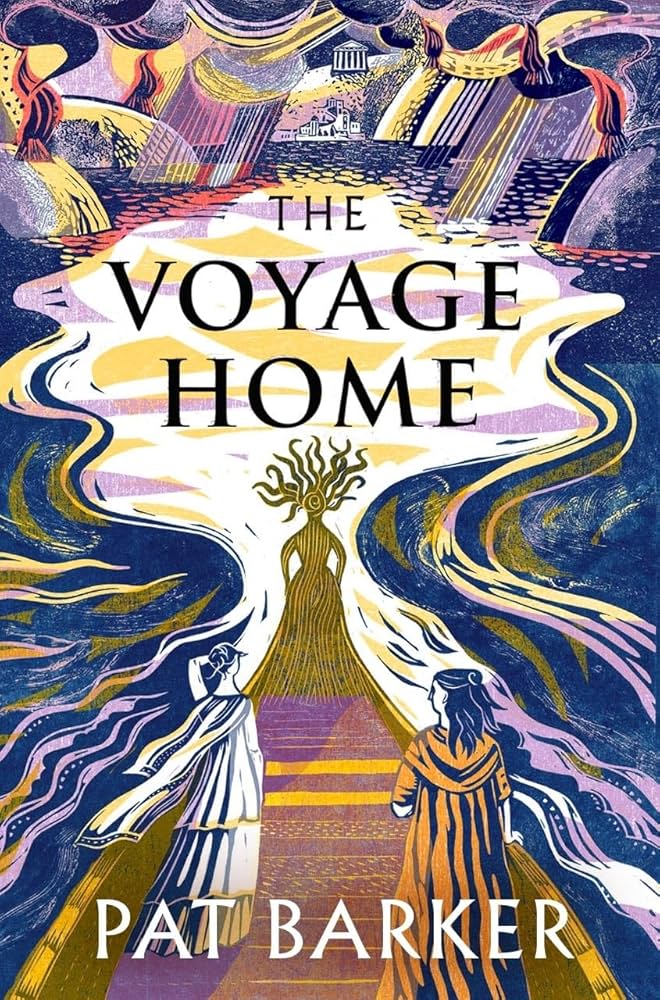
Book Review: The Voyage Home by Pat Barker

‘The Voyage Home’ by Pat Barker was released in 2024, and is the third book in Barker’s story of women from Troy. Although the first two books in the series follow Breisis, Achilles’ slave, this book follows Ritsa, her friend, and one of the slaves who worked in the medic’s tent in the Greek camp.
I really enjoy the story of Clytemnestra, Agamemnon and Cassandra, and was so excited to get the chance to read another story based on this myth.
This story, in following Ritsa demonstrated a lot of rawer, painful perspectives on the lives of Clytemnestra, Cassandra and Electra that I hadn’t previously read, from other retellings, such as the idea that Electra may be disabled, and suffering from a severe skin condition – perhaps something inflamatory like psoriasis, and through the lens of a healer, readers get the opportunity to see different character’s health in a new light; from Agamemnon’s perceived paranoia, and craziness, and Clytemnestra’s grief.
I really enjoyed getting to see this particular myth through the lens of a new character who is intimately close with everyone intrenched in the myth, from her raw and visceral descriptions of the hysteria that Cassandra experiences amidst her curse. I also found it incredibly sad to hear the story of Ritsa’s own rape and assault by Macaheon through her own eyes.
I think that Ritsa’s almost ‘one that got away’ story with Andreas, the captain of The Medusa, Agamemnon’s ship was sad, becuase she knows that even after a fleeting reunion, and the nostalgic revelation that she knew him once-upon-a-time, prior to the seige of Troy. I think the way Barker was able to almost instantly quash any thought of Andreas, and their time together. Even after a one-night-stand of consentual sex, after ten years of being a slave and sexually assaulted. I loved how Barker eradicated any thought of him due to the immediacy of her responsibilities meaning she has no time for her mind to wander, it makes Ritsa’s ending incredibly compelling.
I also found it incredibly compelling to learn more about Electra, and how Clytemnestra has inadvertently continued on the generational curse of one daughter overshadowing the other, like Helen had overshadowed her in the past, and how the phantom presence of Imphigenia overshadows Electra. It was very compelling to see Clytemnestra in this light.
Ultimately, it was a very sad read, but most of Barker’s are. They don’t pull punches, and highlight the nuanced complexities between the different mythological figures, specifically the women.
 Imogen L. Smiley