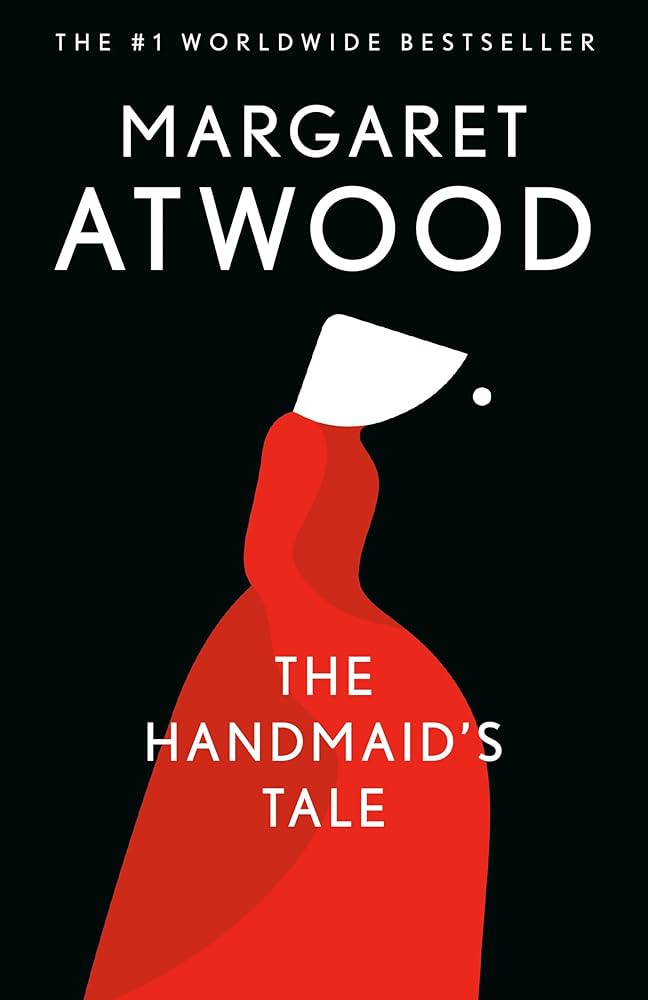
Book Review: The Handmaid’s Tale by Margaret Atwood
‘The Handmaid’s Tale’ by Margaret Atwood was published in 1985. It was adapted into a television series during 2017, which concluded in 2025, however, the events of the series were not canon-compliant, they, instead, explored the potential that came from the ending of Atwood’s novel. However, during the time where the series was airing, Atwood released a sequel. ‘The Testaments’ was published in 2019, a whopping thirty-four years after the initial release of this modern classic.
While this book is on the curriculum for A-Level study in the UK, I was not assigned ‘The Handmaid’s Tale’, when I was at school, or college, or university, so had to seek it out on my own, and I am so glad I did, because it is a book that is going to stay with me for a long time. Its notoriety is well-warrented.
This book tells the episodic story of Offred, a Handmaid in a new version of America known as Galead, where a series of phenomena have left the majority of the population sterile, and fertility issues rampant, forcing drastic social change, within which women find themselves subjegated to living their lives shrouded in red, hidden from the eyes of men, lest they be tempted to have sex with them, and be vessels for babies, but this form of surregacy is forced, non-consensual and thrust onto pre-menopausal women to boost the population. The change was drastic, jarring, and violent, and yet, in fear of her life, Offred complies.
Throughout the book we learn about Offred and her life as a handmaid to her commander and his wife, Serena Joy, who are, theoretically, too old to conceive naturally, and theoretically unable to naturally conceive, but due to overbearing and warped uses of religion, the population are forced to take on the notion that men cannot be sterile, or have their own fertility issues, even though, prior science demonstrated it was possible.
This book was a harrowing, yet insightful tale which demonstrates not only how close extreme puritan religious believes were already coming to twisting womens’ arms through government control, for example, the USA and their increased restriction on abortion and access to safe and medically necessary procedures, even with the wellbeing of the mother in mind.
Through Offred’s recollections, readers are made privy to the ways society changed during her lifetime, with her mother being a member of a loud religious group that protested against abortion, pornography and various other societal taboos, while not perpetuating the puritan views expected of the devout, such as attending church services every week. Furthermore, Offred was raised by a single mother, who justifies herself with the fact Offred was wanted and that ought to outweigh her mother’s means of conceiving her.
I was terrified by the similarities between the world Atwood depicted in this book, and the ways that it resembled and still resembles our pasts and present, with ceremonial book burning, a restriction of information access, the act of banning reading and writing for women, making them unable to take in any written information they happen upon, and the private, exclusive secret world of sex work and brothels where rich and powerful men can still commit adultery.
This book was so powerful, and the ending had me reeling. In my personal opinion, prior to reading the second book, ‘The Testaments’, I would argue that the ending speaks for itself, and the second book is, theoretically unneccesary as the open and speculative nature of the book’s conclusion leaves readers with the opportunity to draw their own conclusions, however, as a fiend for immediate gratification, I reserved the second book from the library immediately, and this opinion could easily change upon finishing it.
 Imogen L. Smiley