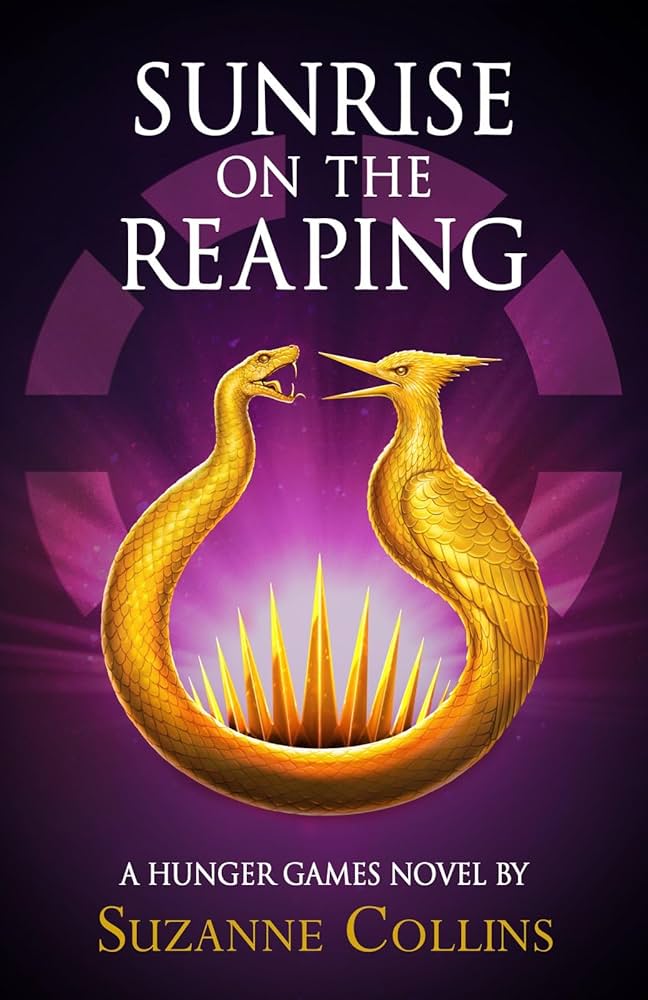
Book Review: Sunrise On The Reaping by Suzanne Collins
‘Sunrise On The Reaping’ by Suzanne Collins was released in 2025. It is the second of Collins’ ‘The Hunger Games’ prequels.
This book follows sixteen-year-old Haymitch Abernathy, and the events of the 50th Hunger Games, the Second Quarter Quell, where there were double the amount of tributes reaped from each district.
From the get-go, Collins makes her intention and message about this story clear, quoting George Orwell before the story even begins, and makes broad notes about the notion of propoganda, something which had been touched upon during previous books, such as Katniss and Finnick filming District Thirteen’s propos during the rebellion. However, this book goes much further into unpicking what can be distorted by the media.
While other authors have explored the nature where journalists can twist people’s words to fit their own agenda, such as the iconic line from the 2004 live-action Scooby Doo film ‘Scooby Doo 2: Monsters Unleashed’ where Fred Jones gets frustrated with reporter, Heather Jasper Howe, and her cutting clips together to broadcast a message that is inherently anti-Mystery Inc., and tells her: “Hey, you’re doing that thing again where you take everything I say out of context. You’re trying to make it look like I think Coolsville sucks- no! Don’t record that!”
Which, as Fred anticipated, was rendered out of context, so all Howe’s audience heard was that Fred “think[s] Coolsville sucks”.
Collins goes far, far deeper into the malicious ways in which a story can be twisted and distorted to fit what the people in charge want, which, in this case, is The Capitol, and she does an amazing job at this, making it clear that the version of the 50th Hunger Games that the readers understood to be accurate through Katniss’ narrative in ‘Catching Fire’ (2009), is not the true version of events as Haymitch experienced them.
I cannot begin to express how much I loved this book. I was astounded by the graphic and grotesque nature of various punishments that were thrust upon characters in the 50th Hunger Games, and the ways in which the tributes and Victors suffered throughout the Games’ history. It allowed me to ponder the greater conflicts and moments within the series and the implications of them, like Alma Coin’s suggestion of a “ceremonial” Hunger Games that included Capitol children, and Johanna’s remark about Snow having a granddaughter and wanting her to be reaped. It offers readers the chance to question even more about the world, the books, the events and whether or not things were rigged.
Through Haymitch’s narration, readers get valuable insight into the ways in which the Capitol has changed since Snow’s ideas for The Hunger Games came into place during the years following his romance with Lucy Grey Baird. With opulent and extreme fashion already commonplace among Capitol citizens, Haymitch and his fellow tributes from District Twelve find the spectacle of their fashion bizarre.
Readers are also given the opportunity to understand the cruelty of overconfident, powerful Capitol citizens, through the character of Drisella, Haymitch’s Capitol escort, and Effie Trinket’s predecessor, who is cruel and wears gaudy, unfashionable clothing, while brazenly brandishing weapons to subjugate the tributes, which she has no qualms in doing. Her apparent distaste towards Maysilee Donner and her attitude is as clear as day and Maysilee’s refusal to back down when faced by a whip was astounding, and a clear indication of what could be to come, not only in the Games, but also upon reflection of subsequent Games.
There are multiple prevalent easter eggs, making reference to multiple characters, events and scenarios that come to be during the original trilogy. I loved getting the opportunity to have insight into characters Katniss didn’t know well during her story, and getting a greater inclination about what may have caused them to rebel against Snow in the first place.
The question of how Haymitch’s games and the experiences he had were skewed, especially with reference to Katniss understanding that he was alone, without friends or family, echoes the sentiments of fellow Tributes in the trilogy, such as Johanna Mason and to an extent, Finnick Odair. It begs the question of how much of their experiences were coincidental, and how much could be a reflection of similar circumstances coming to pass.
Suzanne Collins wrote yet another thoughtful, profound and evocative story, that effectively tore my heart out and stomped on it. I read it within twenty-four hours, and I haven’t gone a day without mulling over something that happened in ‘Sunrise On The Reaping’. I absolutely adored this book. It is probably my favourite one in ‘The Hunger Games’ series.
 Imogen L. Smiley