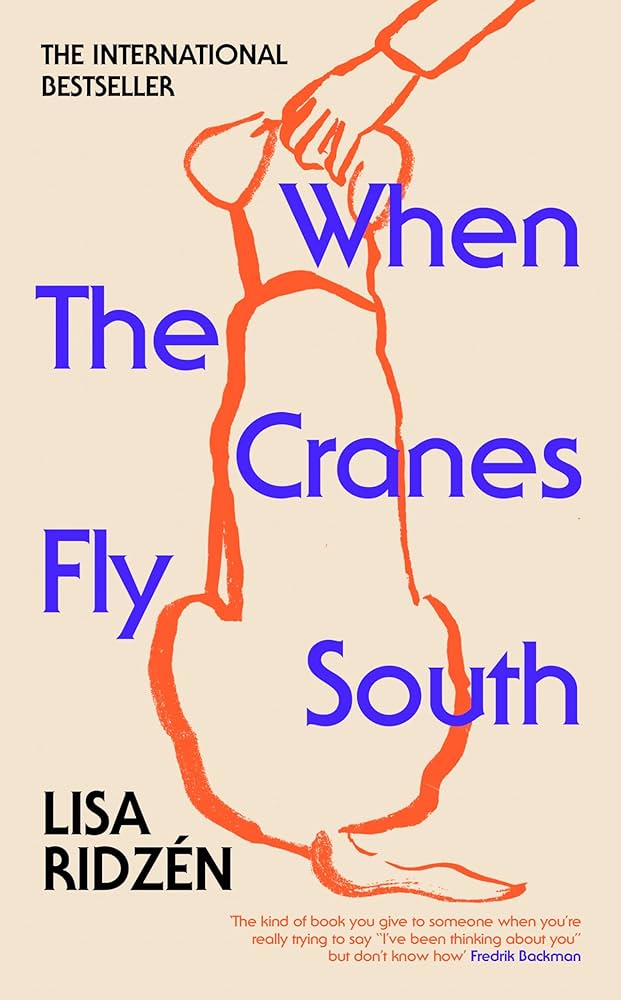
Book Review: When The Cranes Fly South by Lisa Rizden

‘When The Cranes Fly South’ by Lisa Rizden was published in Swedish in 2023, and later translated into English by Alice Menzies and released in the UK in 2025.
This book was one of the saddest, most evocative, gut-wrenching pieces of fiction I have read in a long time, and not just because it is a ‘sad dog book’, though I am sure frequent blog visitors are rolling their eyes.
No, this book is amazing, and not just because of the fact it is a ‘sad dog book’. Because this isn’t a book about Sixten, it is a book about Bo, Sixten’s owner, an elderly man that lives in a rural Swedish village, and has been alone since his wife, Fredrika, was taken into a care home to accomodate for her needs as her Alzheimer’s disease grew progressively more distressing for her to be in her home with her husband.
They have one child, Hans, who has made several questionable decisions in his life, and while Bo has regrets about the ways he raised his own son, he never expected his son to be the primary hurdle in the way of any semblance of autonomy that Bo expeienced.
This book is not only a cry of frustration about growing older and losing one’s sense of autonomy not only over bodily function but also over what you can and cannot do in your home for the ease and aid of the carers that come round multiple times a day. Bo expresses immense frustration with the carers and the restrictions they put upon him, whether its them not feeding him the food he asks for, or not laying a fire correctly.
But the main gripe that Bo has with his getting older is that his son wants to take his dog away. Honestly, having finished the book and recalling the events as they happen is making my eyes well all over again. Because hindsight dictates that there could have been more solutions to keep the pair together, whether it was hiring a local kid to walk the dog, or installing a water filler for the bowl, or even buying the dog a treadmill, and all of those things, while costly, would have likely been a greater solution than the altenative.
I hated Hans’ character in the book, no matter how he and the carers attempted to justify themselves, I could not even begin to forgive Hans for advocating against his father and Sixten, whether it was for Sixten’s supposed welfare or not, and after Hans succeeds and we watch the fallout of his attempt to rehome the dog, I simply bawled and hated Hans even more.
This book is a complex, nuanced story which explores more than just being a sad dog book, but Sixten is the primary focus of a lot of Bo’s behaviour and his love for his dog was clear throughout the book. Similarly, Bo’s frustration about how he was being treated, and the way other elderly people in the care system may feel about their treatment, whether or not it is for their best interests was a prevalent aspect of the book. The last was about the idea of fatherhood and the resentment Bo feels toward his own father while equally resenting his son for his actions, primarily with Sixten but also with his son’s politics and his refusal to acknowledge that the sweets he was buying were ones Bo didn’t actually like. And yet, despite everything, Bo knows he could have been a lot worse and cruel to his son, and tried to do better by him.
I think that what really brought this book to the next level for me was the real-life aspect of the notebook that was left for the carers, where, whoever was on shift would make a record of important things the next person ought to know about Bo’s day thus far, whether it be something nice, like Bo’s reminiscing about his wedding with Fredrika or Hans’ childhood, or something concerning, like a remark he made about a car toward the mid-point in the book which makes readers realise where Hans may be coming from, even if they don’t agree with it.
Being able to empathise with Hans made me even more frustrated as a reader, because while I understood where he was coming from, I still didn’t agree with his solution.
This book broke my heart, tore it from my chest and ground it into dust, it was a poignant, evocative, and harrowing story of companionship, loneliness, grief, longing, and autonomy. I sobbed while hugging my dogs after I closed the book, and haven’t been able to get it out of my head since. Read it. Definitely read it.
 Imogen L. Smiley