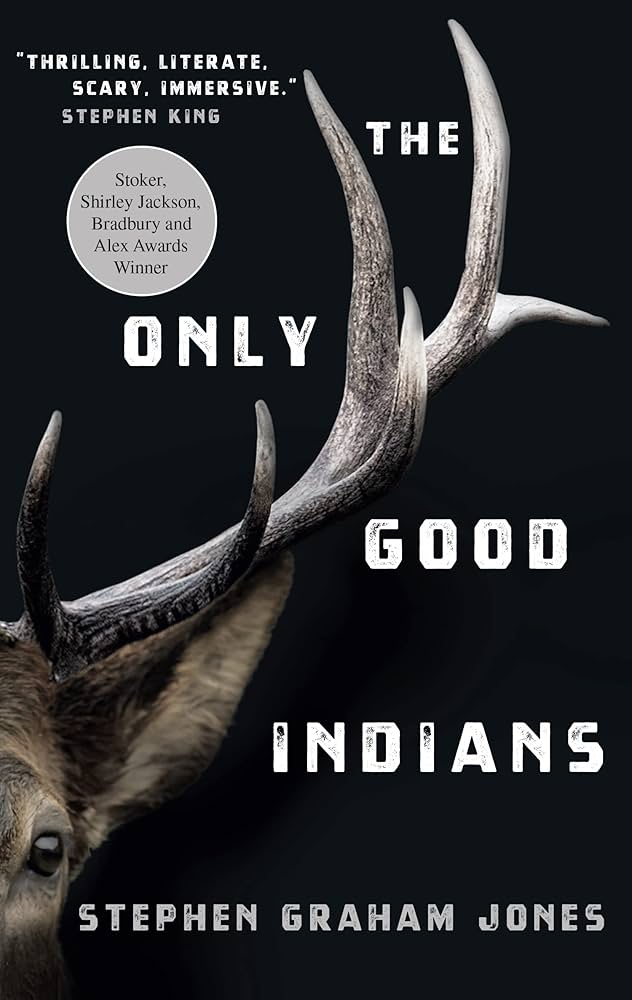
Book Review: The Only Good Indians by Stephen Graham Jones
‘The Only Good Indians’ by Stephen Graham Jones was released in 2020. It is one of his more recent works of fiction. The book is Own Voices, and follows a group of men who killed a group of elk in the lead-up to Thanksgiving ten years prior to the start of the story: Ricky Boss Ribs, Lewis A. Clark, Gabriel Cross Guns and Cassidy Sees Elk, and the consequences of an elk massacre on land they weren’t supposed to be hunting on.
All four of these men were indigenous and lived on a reservation as part of the Blackfeet tribe. The book delves into poignant themes of generational trauma, institutional racism and makes a clear point of discontent about the way that the Native American population were treated in the wake of white settlers coming and colonising their lands.
There are many potential triggers in this book, particularly when it comes to the idea of violence against animals, and not just game, but domestic pets, too. There are also graphic depictions of violence, slaughter and violence against women.
I was intrigued by the premise of this book, not just because I studied the Native American Genocide during school, but due to the promise of something uncanny and harrowing coming after the characters like some kind of ghostly apparition, hellbent on vengeance.
The story follows each of the four young men involved in the slaughter of the elk, and their deaths. While Ricky Boss Ribs was killed not long after the initial “Thanksgiving Classic”, as the characters called the murder of the elk, the other three perpetrators take far longer to die. It is in the weeks leading up to the anniversary that guilt begins to eat the characters alive.
Readers follow Lewis A. Clark next. It’s been almost a decade since he killed those elk, and he was quick to leave the reservation, entering a whirlwind romance with the woman that became his wife, a white woman called Peta.
He isn’t the same man he was. Having moved into his new house with his wife, and holding down a steady job at the post office while Peta works at the nearby airport, he is determined to learn how to fix some of the things that don’t seem to work around the house, such as a ceiling light with a motorised fan. While standing on a ladder, trying to fix the lightbulb, so it will actually turn on when a switch is flipped, he sees something on the living room floor through the blades of the ceiling fan: a dead elk on the carpet, one he shot during the “Thanksgiving Classic”. One whose pelt he still carries with him.
As the memory of what he did to the elk is dredged up to the forefront of his mind, and things begin to go wrong in his life, Lewis finds himself paranoid, convinced he’s being haunted by the ghost of a pregnant elk he shot, the elk whose pelt is in his garage. He struggles to rationalise himself, and is convinced his family isn’t safe, and takes things into his own hands, fleeing his home with more blood on his hands than there had been ten years ago.
After Lewis, the story turns to the grand finale, with the “elk-headed woman” that drove Lewis to his death, returning to the reservation to finish the job, by killing Gabriel Cross Guns and Cassidy Sees Elk. Except, like Lewis, ten years has given them enough time to grow up. Cassidy has a partner, a woman called Jo, and credits her for all the positive changes in his life, while Gabe is the fiercest father, wanting to do the best by his daughter, Denorah, who was only a few years old when the events of the story began, and is determined to try and keep some of the culture and customs alive in the face of another generation of angry kids, justified in their rage at the injustice of how they’re treated.
I liked how the pacing worked with each individual installment of the story, from how the elk-headed woman haunts the various characters and brings them their comeuppance, wreaking havoc in her wake, whether or not she meant to.
I was really interested in the ways that her revenge was exacted, and the satisfaction that came from the story’s resolution. The rightening of the otherworldly wrongs with the untainted, unbloodied generation, and how Denorah was able to do what was right, not just physically, but spiritually. It was a very rewarding conclusion to the story.
I’d definitely recommend ‘The Only Good Indians’ if you’re looking for a read that will keep you questioning everything, from the sanity of the characters to the only way things could be resolved. I really enjoyed how the events played out, and really made me think, not only about the concept of hunting, and the meat industry as a whole, but of the gravitas of generational trauma, and the idea of breaking the cycle. This book was incredibly satisfying, in that respect, and while being mindful of your triggers, I’d definitely recommend it.
 Imogen L. Smiley