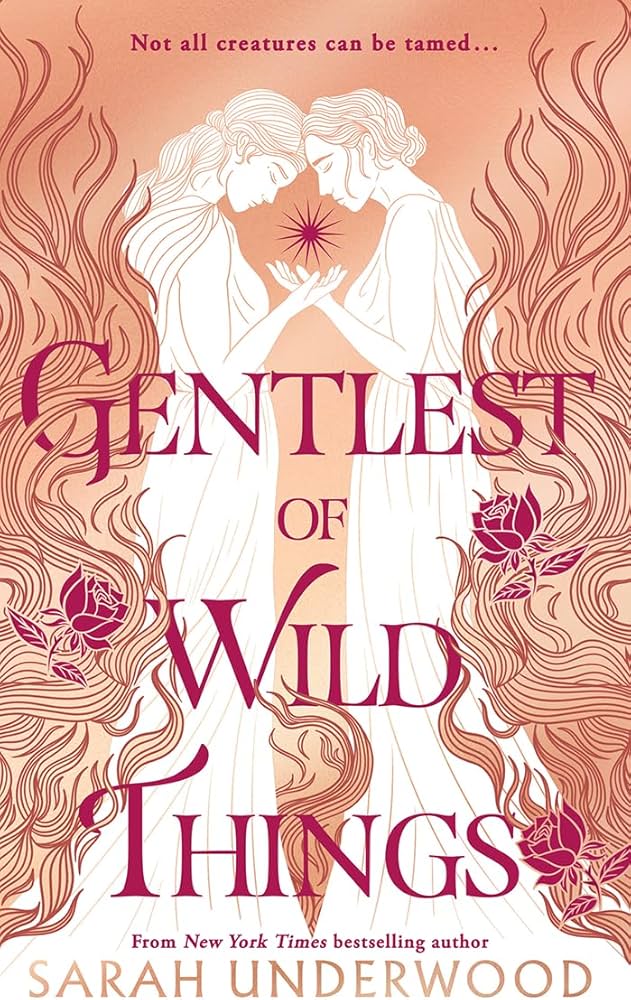
Book Review: Gentlest of Wild Things by Sarah Underwood

‘Gentlest of Wild Things’ by Sarah Underwood was released in 2024. It is her second novel and happens during the same universe as her debut, ‘Lies We Sing To The Sea’, which is set on Ithaca, Odysseus’ homeland, generations after his passing, where the Isle is still indebted to Poseidon after Odysseus blinded Polythemus on his voyage home from Troy.
Unlike ‘Lies We Sing To The Sea’, set on Ithaca, ‘Gentlest of Wild Things’ is set on the nearby island of Zakynthos, where Desire is power. This book is based on the myth of Eros and Psyche, where a descendent of Aphrodite has found a way to turn women into passive, obedient and dumb wives to much older, rich men through his magic product, Desire.
Robbing the nearby village of its young women and growing rich, powerful and influential, the young Leandros has the makings of a vindictive monster of a man, and few see this more than Eirine, a young woman who has watched her friends willingly wed men old enough to be their grandfathers, swept away into the night, as if they were never there. She remains in her village, one of the few women of her age who doesn’t work in the brothels in town, doing everything in her power to support her twin sister, Phoebe. While Eirine and Phoebe are twins, a childhood illness savaged Phoebe’s immune system, leaving her quick to sicken. A weaver by trade, Phoebe often remains indoors and safe, until Leandros’ wife, Alexandra, mysteriously dies, he must take another. And he chooses Phoebe.
Desperate to save Phoebe from Leandros’ clutches, surely to be struck dumb by Desire and become his dim, thoughtless, object of a wife, Eirine seeks Leandros out, and is subject to four tasks to save her sister. She is locked away in Leandros’ palace, where she meets his wraith of a daughter, Lamia, neglected by her father and too scared of the world outside her tower to dare step a toe out of line. But, why, if it is her father’s magic, and his products that has turned Zakynthos into such an undesirable place to live?
I read this as an audibook and absolutely loved it. Underwood wrote an incredible tale of love, devotion and the lengths one would go to for someone they care for.
I loved so many elements of the story, from Lamia’s name, which happens to be the same name as Keats’ poem about a spirit who seeks love from a human man and the powers and dangers of love. It was the perfect name for her character, to the way Underwood depicts the process of being Desire-d, which was even more terrifying when listening to the audiobook.
I thought the pacing and character development was incredibly compelling and a great fit for each of the various tasks Eirine is set. It really worked that while each task was momentous in of itself, the way it was written depicted the long-suffering element of the first task aptly, and cleverly.
Leandros’ character and his arc as this loathesome villain, turn doting father, that isn’t all that doting was very engaging. It made Lamia’s development all the sweeter. I loved how, at the end, you can reflect on seemingly random things Leandros had procured and realise why they were there. It was very clever.
I also really enjoyed the strong character voices that Underwood was able to convey, which was enhanced even more so by the fantastic voice acting work from Fern Kay and Isabel Adomakoh Young. You immediately get the sense that Lamia isn’t confident, and is completely beholden to her father’s expectations, wants and whims, meanwhile, Eirine is stubborn, headstrong, and rude. She doesn’t fear Leandros for the same reason Lamia does, and hearing both Kay and Adomakoh Young’s interpretations of the other’s voice was also fantastic.
I would definitely recommend this book, it is a fantastic stand alone novel, and I thought the quick nod to Eirine and Phoebe hailing from Ithaca and the fact “you don’t keep two daughters on Ithaca” was a great nod to her first book with the double meaning being either a reference to the curse on the island or, perhaps, had you been unfamiliar with it, one could read it as a reference to the men on the island. It was a powerful tale of feminine rage, the lengths one would go to for love, and how its never too late to leave an abuser. I loved it.
 Imogen L. Smiley