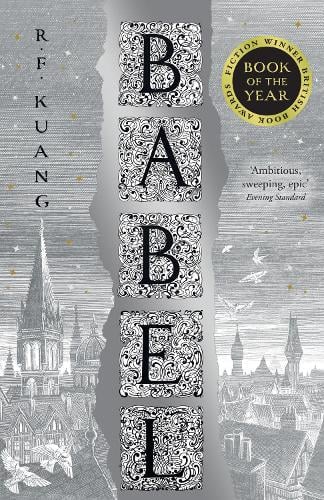
Book Review: Babel by R. F. Kuang
‘Babel’ also known as ‘Babel, Or the Necessity Of Violence’ or ‘Babel: An Arcane History’ is a novel by R. F. Kuang. It was published in 2022 and is her fourth book.
It is what she describes as a piece of speculative fiction, however, this alternative history novel has fantastical elements that have led fans to classify it in the fantasy genre as well. It is a popular dark academia read and is set in 1830s Oxford, following a group of young scholars attending the Royal Institute of Translation at Babel.
While it is important to acknowledge the journey of the characters, before I gush about my live of thus book, it is worth acknowledging that Kuang’s world is sustained under the power of silver, the precious metal, due to its peculiar magical qualities, that have become so commonplace in sustaining life in the UK, whilst being wholly inaccessible in poorer countries. Not because the countries lack their own silver, but because the knowledge is a close-guarded secret. In order to use silver bars, you need match pairs, words from different languages that are similar enough to curate a suscinct and tangible meaning. Thus the need for translators.
The story primarily follows Robin Swift, a Chinese immigrant who wad taken on as a ward by a famous and influential scholar at Oxford, Professor Lovell. When Robin is finally able to attend lessons at university, he is astounded by the racism in this smaller, more rural part of England, while also finding himself enchanted by the sense of belonging he feels among his classmates and cohort during his years of study. However, he finds himself entangled in the illicit behaviour of an underground organisation The Hermes Society, who seek to use the knowledge in Babel for their own anti-empirical means. This book is anti-colonialist whilst also acting as a love letter to the scope of language, and the many ways people can communicate.
This book was filled with so much anger and purpose. Robin, Ramy and Vittoire’s sense of community, solidarity and togetherness was so interesting, especially when it began to fracture.
Though the most complex, and frustrating character, by far was Lettie, and while, readers can understand her standpoint about gratitude from her perspective, through her experience, readers, however, I felt like tearing my hair out about how blind and ignorant Lettie was.
I loved this book. I studied language development and how words and their meanings shift through time during my A-Levels and loved how the idea of obsolution and archaism as well as the spread of language being something the institute, and thus The British Empire is struggling with. It was a clever ode to the development and the power through diluting and interchanging words and dialects, and words being recognised for their various meanings. This means, within the world Kuang has created, the professors at Oxford need to search for different languages through the countries the Empire has colonised, and recruit young scholars through malicious means to acquire them, stealing young children from their families and homelands under the guise of acquiring a greater education and better opportunities.
The way that Kuang told this story was imbued with so much adoration and appreciation for language, as opposed to the anger about the way colonialism impacted other countries through the slave trade, and trying to go to war with other countries to overpower and subjugate them. Towards the end of the book, the characters are sent to Canton, where Robin grew up, in order to settle political disputes between the East India Trading Company and the Chinese Emperor and his people. The issue at hand? Opiates. The British are making their way into China with opium, grown in India, and putting this addictive drug in the hands of the poor workers, getting them addicted.
I loved this book, so, so much. It told an important, poignant story and rendered me a R. F. Kuang superfan!
 Imogen L. Smiley