
Book Review: Felix Ever After by Kacen Callender
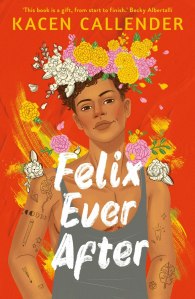
‘Felix Ever After’ by Kacen Callender was their second young-adult novel, and was released in 2020. The story follows seventeen-year-old Felix Love’s life after he is the victim of a malicious hate-crime, where old photos from his Instagram, pre-transition, were blown up and put on display in the foyer and gallery space at the art school he and his best friend Ezra attend: Saint Catherine’s.
If that description doesn’t tell you enough – although this story is necessary, and brilliantly written, it could prove incredibly triggering, since it contains many instances of transphobia, throughout.
In response to the hate-crime, Felix accuses his best friend, Ezra’s ex-boyfriend Declan, who hates him, as being the person behind the gallery. In a bid to get revenge, he decides to catfish his classmate to expose his secrets. But, this plan quickly falls to the wayside when real romantic feelings come into play, as well as the pure, unadulterated truth that it wasn’t Declan who made a spectacle out of Felix’s transition and plastered his deadname over the gallery space.
Now, I do not condone what Felix did, but I loved the way that this offered a new glimpse into Felix’s character. He wanted revenge, he wanted to express the anger and hate that was bubbling up inside him and scapegoated, assuming Declan would have been hateful enough to his ex, and former friend, to expose him like that. And, there is only more kindling thrust onto this metaphorical fire, when at the same time that Felix is messaging Declan, he starts receiving anonymous Instagram messages from grandequeen69, harassing him for his identity, supposedly the same person that put up the images in the gallery.
Throughout the story, we see different sides of Felix, the version of himself he wants to present to the world, and Lucky, the persona that he uses when messaging Declan. Although Felix is honest with Ezra and the friends he makes during the summer, he doesn’t confide in them the same way he does with Declan, because he’s anonymous. Just like how grandequeen69 wouldn’t tell Felix how they felt about him in person, anonymous identities make you braver.
This story delves deeply into themes of identity and community, and how you could be blocking others out in forging a safe space for yourself. Felix gets glimpses into the wider world of queer identities when, on a whim, he decides to attend a local LGBTQ+ community group on gender identity, and is introduced to five different people that offer their perspectives on issues that are plaguing them in the wider world, whether it be a feeling of discrimination, self-imposed, or societally-imposed exclusion or being faced by the brunt of not having the same privileges other people in the LGBTQ+ community have. I feel like Felix’s experience navigating the world of privilege is incredibly insightful, because everyone can be aware of their privilege and the disadvantages that society imposes on others, whether that be through a patriarchal or racist, or homophobic lens, but not know how to make things easier for others. He feels resentment toward his richer peers, who can afford to live free, fun, easy lives and enjoy their summers, despite the lingering pressure that hides behind them. Ezra is loaded, he has his own apartment, paid for by his rich parents, who fund his lifestyle of casual drug use, art school, cheap alcohol, and fast food. He is comfortable, and self-assured when he is in control of the version of himself that he puts out into the world. He is Ezra Patel, after all. And Felix envies the financial security that comes from having such rich parents. His dad is working himself into the ground to afford Saint Catherine’s. But at the same time, Felix doesn’t consider the plight that could have befallen himself had his father not accepted him as trans, when he came out, like many other young queer people might. He has the comfort and security of knowing he can be who he is, and not fear being kicked out.
Although I hated Marisol’s character, as Callender likely wanted readers to, she was an invaluable glimpse into the territory of trans exclusionary radical feminists, making her the prime suspect, for me, at least, to be grandequeen69, and behind the gallery. Primarily because when she broke up with Felix, she blamed the ending of their relationship on his gender, spouting transphobic rhetoric. She demonstrates how poisonous those ideas can be, and how, the second her nature was revealed, her friends dropped ship – because she wasn’t sorry, and didn’t think anything was wrong with what she’d said. And what I thought was fantastic, was that Callender tells the story in such a way that Felix begrudgingly gives Marisol a chance, and the second she admits she feels no remorse, we barely hear about her again. She gets very little air-time, and if I remember correctly, basically no dialogue after that. Felix’s network band together and support him, and Leah, who was an amazing character too, declares that she knows Marisol has a lot going on, but doesn’t use that to excuse her behaviour, nor does she force anyone to listen to Marisol’s plights, she is wrong, she is unrepentant, she is therefore, no longer part of the group. As it should be. Queer people suffer enough systemic oppression without attacking one another, safe spaces, like social circles, are for everyone and hate like what Marisol spouted was just wrong. I’m glad Callender provided such a clear yet nuanced comeuppance for Marisol. They did it brilliantly.
I loved how the theme of love was explored throughout the story, too. Declan and Ezra as respective love interests offer Felix different paths, different challenges, and different perspectives on life. Declan resents that he finds out who Felix is the way that he does, and is angry about being lied to, strung along, and hurt the way Felix hurt him. He also wants to remedy their reality with a wave of a magic wand instead of communication. While Ezra is consistent, he is nurturing, and encouraging, and was perfectly content loving Felix in secret. He is stung by the rejection but didn’t want to lose Felix, he needed space, but they communicate. They’re best friends. Another thing that I loved was that it was Declan’s suggestion of Felix being active in the events around him that helps him come out of his shell, and inadvertently plays a huge part in exposing Marisol’s transphobia.
Lastly, can we just applaud Callender for their ability to navigate the theme of separating art from the artist, especially in a book where Hogwarts houses are directly compared to horoscopes in how farcical and unnecessary they are in the wider world – and question why we use them to define ourselves? They offer a clear insight into the argument, with Felix saying “I mean, isn’t all art a piece of the creator’s soul? If the creator is an evil piece of shit, doesn’t that mean we’re being influenced by evil in their work?” and “Propaganda against different races, illustrations depicting groups of humans as lesser than other. Art for the sake or far, without any regard to other people –”. It is incredibly clever for Declan and Felix to argue about morality and art, especially when he is still suspicious that Declan is the one behind the gallery at the time.
This book was so much fun! It took me on a rollercoaster, and I certainly didn’t expect the twist at the end. I would recommend it, absolutely, just, like I mentioned above, it is important to be mindful of your triggers!
 Imogen L. Smiley