Book Review: Kiss by Jacqueline Wilson
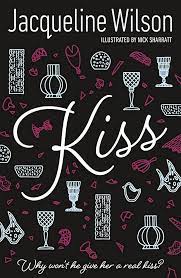
‘Kiss’ by Jacqueline Wilson was one of my first introductions to the idea of queer people. I remember being twelve years old, and I hadn’t even watched an episode of ‘Glee’ yet! I’d only seen gay characters in the form of Mitch and Cam from ‘Modern Family’.
I was browsing the Jacqueline Wilson books in my school library after school, I saw that title, and didn’t immediately recognise it. It was an age-restricted book, and by the time I was old enough to check it out, the library had long-since closed to build more classrooms. So I never got the chance to read it at the time. But, I finally got my hands on what I consider a significant relic of queer literature’s past. ‘Kiss’ by Jacqueline Wilson was published in 2007, and after sixteen years (oh my GOD!) I’m finally going to talk about it.
‘Kiss’ is a coming of age story, which in hindsight, really shouldn’t have been age restricted at my school. Not when Wilson’s other books for teens were readily accessible. The story follows thirteen-year-old Sylvie, who is head-over-heels in love with her best friend and next-door neighbour, Carl, and yearns to escape the world of social hierarchy and rumoured sexploits and into the imaginary haven that is Glassworld, where she and Carl play. But Carl doesn’t have the same enthusiasm for those games anymore. He’s at the local all-boys grammar school and has new friends like Paul The Ball, ace footballer.
This book explores the idea of coming into yourself and growing up, blending warmth and comforts of what is familiar from childhood, like Build A Bear Workshop and playing pretend, to playing spin the bottle, drinking in the park, navigating periods etc.
Carl’s character is synonymous with glass. He’s fragile, supposedly transparent, and blends in with his peers. He loves ornamental glass, and is a hub of knowledge about it. Although his collection of glassworks is initially seen as an oddity by Carl’s new friends, Paul and Miranda, Miranda takes his quirky interest in stride, buying him an extravagant glass ornament, and suggesting visiting Kew Gardens for his fourteenth birthday, which is when things go awry for him.
‘Kiss’ navigates the idea of sexuality in equally gentle and scathing ways. While Sylvie is sheltered as if she’s covered in bubble wrap and daydreaming of a big white wedding with the boy next-door, Carl’s mind has wondered and he’s fallen in love with Paul, the goofy, laddish, football boy. He’s good looking, smart, good at sports, and he’s nice to him. Carl wants to impress Paul, so he declares to Sylvie that they should go bowling with Paul and Sylvie’s new friend, Miranda, and fun birthday parties playing at friends’ houses change starkly to a trip to Kew Gardens to look at the glass ornaments.
When Carl’s love confession is ill-received, his world is thrown upside down, and the reader gets to see the depth of some of the other characters like Carl’s older brother, Jake, an angsty goth boy in a rock band, who teases his brother senseless, yet the second Carl is upset at school in the fallout of his kiss with Paul, Jake is ready to send fists flying in Carl’s defence. It’s sweet, and I loved that!
Miranda was such an interesting character. I loved how nuanced she was and how reading about her was like observing through hundreds of small fragments of glass. Pun intended. I loved the motif of fragility through the use of glass! But back to Miranda, as the new girl at school, she has to find where she fits among her peers. Therefore, she isn’t necessarily being her authentic self. It seems that each choice she made was deliberate and purposeful, and she seemed like the kind of stereotypical mean girl character that uses the naïve protagonist for her own benefit, but there’s more to Miranda than that. As I was introduced to her, I instantly found myself fretting she was like my own secondary school bullies, worried she was inviting Sylvie to a party that didn’t exist, but she was raw and vulnerable. I wanted to know more about her.
I felt sorry for her. That’s the point of her. Miranda is unkind to Lucy. If this was Lucy’s story, she’d probably see Miranda in a much more two-dimensional way. But the Miranda Sylvie knows just wants to be loved. Her parents had no time for her, her au pair had no control over her, she was using her body to curry favour with others and yet she’s shamed for eating what she wants. She’s barely fourteen! Fourteen, and her mum is telling her she needs to watch her weight and stop eating cakes and pizza, but it just echoes a need for control and a lack of it that Miranda’s mum, who is clearly struggling with an eating disorder has.
Honestly, if I were her parents or even her au pair, I’d be more concerned that Miranda was drinking vodka, and bunking off school after sneaking offsite to visit McDonalds and go clothes shopping, or sending photos of her boobs to a boy, and him sharing it. Unfortunately, that was something I know happened among kids when I was at school, and certainly still does now. It’s sad, and demonstrates that although elements of this book have aged like milk, such as Sylvie’s reaction to her mum online dating, and believing she is on some sketchy chatroom, instead of being desensitised due to the sheer volume of ads teens are exposed to that promote dating apps etc., the distribution of explicit or intimate images, which is now known as revenge porn still runs rampant among schools.
One of my favourite moments, however, was when Sylvie started her period and hadn’t worked out how to use a tampon, and had been teased by her Mum about flushing a sanitary towel down the toilet, and gently told that’s not how to dispose of them since they can and will clog a toilet, but when she’s at school, and asks her friend Lucy about how she handles PE when she’s on her period, and Lucy informs her that your sanitary towel can flood, or leak, and Sylvie panics. Miranda is the one who ends up helping her, giving Sylvie a tampon, and instructions on how to use it while in the girls toilets. The girls toilets really are a pinnacle of heir friendship in this story, since its where they first started talking, and when they demonstrate their friendship isn’t superficial at all.
Jacqueline Wilson often tells hard-hitting and emotional stories that cause anguish, so I didn’t go into ‘Kiss’ expecting Paul to reciprocate Carl’s feelings, but what did hurt was how Sylvie and Miranda get a glimpse into the bullying Carl experiences after being outed. Frustrated, he lashes out against his glass collection and cuts his fingers to ribbons, spending ages in A&E with his family that same night. Thus resulting in Carl’s coming out story being “oh yeah, I came out to my mum in the waiting room of A&E”. In a bid to be kind, supportive friends, Sylvie and Miranda meet him at McDonalds at lunch, and skip the rest of the the school gates the day after he is outed, and walk him home.
I liked that although Sylvie was doing wrong in bunking, she was there for her friends, which is ultimately more important, especially considering what Carl was going through. It demonstrates the value of friendship. Despite its age, it still tells a story that ought to be heard. I’m glad I finally read it.
 Imogen L. Smiley