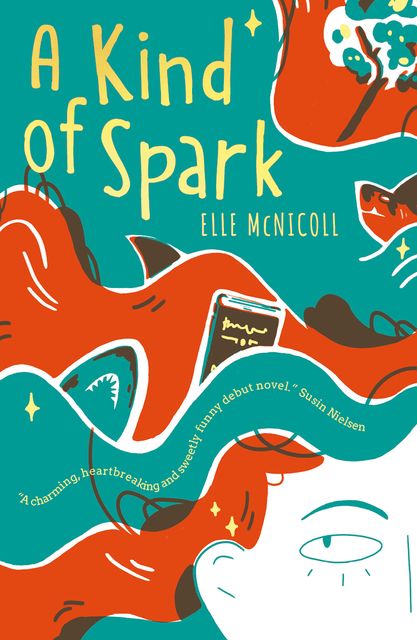
Book Review: A Kind Of Spark by Elle McNicoll
‘A Kind Of Spark’ by Elle McNicoll was released in 2020 and was her debut children’s fiction novel. It follows Addie, an eleven year old girl, entering her final year of primary school. She also happens to be autistic.
Firstly, shout-out to McNicoll for having her debut feature a young autistic girl as her main character. Autism in girls is something that often gets missed due to the stricter social pressures that impose masking on them from a young age, so for Addie, and her older sister, Keedie to be explicitly autistic from the get-go. Having canonically neurodiverse characters was so exciting to see, because it explicitly demonstrates the scope of things like autism.
I related to Addie from the get-go. As a child, I was incredibly creative, and loved to tell stories even in places I shouldn’t have done. I’d been writing my stories at the back of individual exercise books until my classwork and my fiction met in the middle. Until I got caught, that is. And when I was given the chance to be creative, I would jump through hoops for the chance. Addie’s love of telling stories was such a positive character trait that I latched onto immediately, which of course, led me to instantly hate her new teacher, Miss Murphy, who wasn’t supposed to be in Year Six that year. Having a nasty teacher you fear is out to get you is part of the childhood experience. There’s always that one teacher where there’s friction, but when you don’t understand why they dislike you, that rejection hurts. It really hurts. The more we read about Miss Murphy, the more I wanted to weep. She was every rude teacher with archaic ideas about what was appropriate in a school environment and viewed children that struggled as causing problems. God, I hated her. I likened her to teachers I had disdain for in education. The lack of description of her made that very easy.
Another thing that had me relating to young Addie was when I had the chance to read about her former friendship with Jemma, who lost interest in Addie and moved on to befriend Emily, another girl in their class. In contrast, I loved Audrey, not only because of course the sweet child would be named after the man-eating alien plant monster Audrey II, and she was patient, asked questions and didn’t try to be nasty. Anything she said that upset Addie or the other characters was said in ignorance, and innocence, not malice. She learned from Addie’s answers and supported her friend because Addie made her feel welcome!
I loved McNicoll’s use of extended metaphors for ableism, in tandem with advice from older autistic people, and explicit depictions of children’s malice and vulnerability. It was very effective and I sobbed for the last twenty five-ish pages.
Autism and other neurodiversity being likened to the local witch trials was incredibly poignant. The idea of self-fulfilling prophecy, coercion, and vulnerability was so sad. But it made so much sense. Fear mongering people sought vigilante justice on the people who didn’t conform to their supposed standards. Just like how Addie was being bullied, not only by her teacher but by her classmates. I hated reading her struggles, because I related to her anguish at times.
Then there was Keedie. I loved Keedie. She was a role model fro her younger sister, and a long-term victim at the hands of an institutionally ablest society. Addie worships Keedie. She idolises Keedie, and wants to be like her when she’s older. But Keedie is still struggling, more than she lets on. Having started university, she is masking around strangers, unsure if she feels safe enough to be her true authentic self, whilst managing the new workload, and everything else happening around her. It was a lot, and although Keedie was treated with respect within the home, it’s clear she is tired. Tired of the world being so cruel. She suffered under nasty, ableist teachers’ thumbs for years, and she is angry that they still hold authority, and can continue to do that to other kids. My God, and I thought I related to Addie.
It’s sad. Talking to neurodivergent people about the things that teachers did. Was it actually for the childrens’ own good because to me, it seems that ignorance and ableism just produces angry adults, who may or may not be traumatised from their ordeals. Keedie certainly didn’t feel safe. Seeing her rip off people’s heads was incredibly cathartic, and I was empowered by her doing it.
I cannot even begin to tell you how much I loved this book. I sobbed and sobbed and it was so worth the emotional turmoil. I was a wreck and it was cathartic as Hell. Everyone should read it for a glimpse into an autistic girl’s head. Everyone. I can’t recommend it enough.
 Imogen L. Smiley