
Book Review: Lessons In Chemistry by Bonnie Garmus
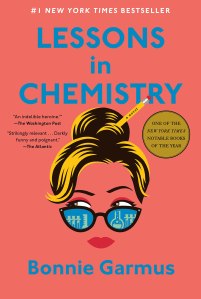
‘Lessons In Chemistry’ by Bonnie Garmus was released in 2022. It was her debut novel, and received great acclaim due to its frank nature, and upfront depictions of sexual violence and misogyny. It wasn’t a book I would have necessarily bought, but I was swayed by BookTok, which praised the novel, and decided it was worth a punt.
I cannot recommend listening to this book as an audiobook enough. The use of the narrator, Miranda Raison’s intonation, and cadence really encapsulated the personality of Elizabeth Zott. Her narration was cool, soothingly delivered and yet, incredibly impassioned. She feels great injustice in being a woman in science, especially in the 1950’s.
Despite the ranting and raving I am about to do about how much I loved Elizabeth Zott, my favourite character was actually her dog: Six Thirty. Named after the time she encountered him as a stray on the California streets. He is an incredible character with clear fears and loves, and things to drive him. As a dog should, he has his person, who is clearly Elizabeth, whom he would do anything for. But what I loved most about him, was his ability to narrate. As a person whose dogs offer a running commentary on their days, narrated by other people in the house, I find that dogs can be incredible conversationalists. My dogs always know exactly what to say. Mostly because I put words in their mouths, but having a stream of consciousness that follows Six Thirty really resonated with me as that kind of dog person who lets the dog speak “for itself”. I loved Six Thirty’s unwavering devotion to his family, and how he was so dedicated to his mission to protect Madeline for her parents’ sake. I loved him. I wept when ambiguous audiobook narration, and my inability to work out where the comma may have been placed in a sentence, implied Six Thirty was going to die. A way to make sure I don’t DNF your book because of emotional turmoil is simple: never, ever, ever kill off the dog. Especially when he’s such a compelling narrator.
On the topic of narration, I was amazed by the blunt nature of Garmus’ use of character voice. She makes it clear that these characters are unhappy, and is very upfront about the way Elizabeth feels about people, her circumstances, intellect, and what she considers foolishness. I also loved how she built relationships, not only with other women, but with men.
Her notoriety in her field was what made women at the Hastings Research Institute hate her. Men at her workplace hated her too, assumed she wasn’t as smart as she let on. Which made her power-couple status with famous chemist, Calvin Evans all the more infuriating. While Elizabeth and Calvin would have loved each other regardless of Calvin’s fame, the societal expectations they rejected were what irked their colleagues all the more.
But what I loved the most about the story, which was only enhanced by Raison’s narration was the feminist themes. Elizabeth strikes me as a woman who would have fit in perfectly among the women in STEM in 2023, though, my apparent inability to name women in science even now demonstrates Elizabeth’s purpose, not only as a character but as an icon to symbolise a need, something society still lacks, incredibly well.
I loved that Elizabeth. She was a fantastic character with a lot of depth, emotion, logic and power. But also, never enough power. She was a 1950s feminist, and furthermore, she was the kind of feminist that didn’t look down on housewives. I loved that when she was hosting ‘Supper At Six’, she spoke to her primary demographic like capable, intelligent women, something that made her television show all the more popular. Elizabeth Zott was a woman who respected the struggles of the housewife, which is why her friendship of homemaker Harriet Sloane was so fantastic. Despite their age difference, seeing Elizabeth and Harriet bond in such an intimate way, over their mutual love for Elizabeth’s feisty new-born, Madeline.
Furthermore, her clear sense that there needed to be more women in science and that the glass ceiling was a ridiculous concept that shouldn’t keep ambitious women from following their ambitions, nor should having husbands and children, was fantastic. A sentiment that demonstrated that she really was a figure the contemporary woman of the book’s target audience would resonate. Only to be struck by realities of life in the 1950s and early 1960s. There was so much frustration on my part that society in the story hadn’t reached where we were now, I wanted to shake so many characters by the shoulders and scream. It was a great method to show not only how far society has come but how far we have still to go. And I loved how, by the primary subject of the story being Elizabeth and her determination to continue her career in chemistry echoed this. It was incredibly clever. Science in the 1950s had developed significantly, but there was a long way for the field to develop even between then and now, and even now, there still is a long road ahead for science.
I loved this book so much. Especially, as I said, in audiobook form. Garmus told an incredible story, and Raison told it with a poignant and intimate sense of keeping a precious secret. I loved feeling as if the book was being told to me in confidence, and hearing how the pieces of the ever connected puzzle that was our world came together. It reminded me of something a friend once said to me: you are made of the same atoms that started the Big Bang. Something that I likened to the concept of Elizabeth’s study of abiogenesis. I cannot recommend ‘Lessons In Chemistry; enough, it was easily one of my favourite reads of 2023!
 Imogen L. Smiley