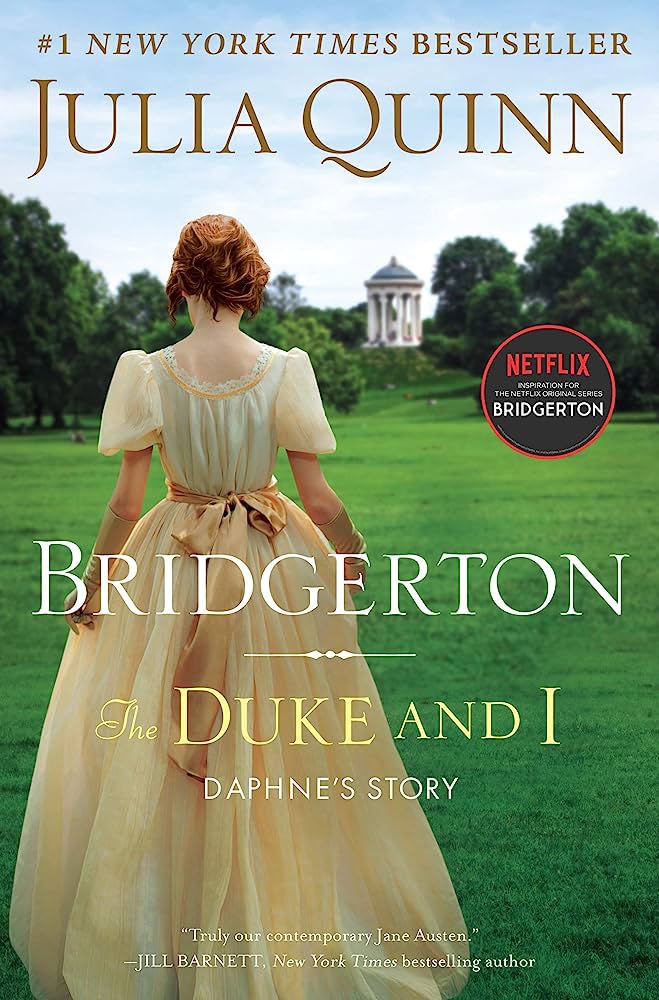
Book Review: The Bridgerton Series by Julia Quinn
Julia Quinn’s ‘Bridgerton’ series consists of eight novels, each of which tell the story of one of the late Viscount Bridgerton’s eight children. The books were released between 2000 and 2006, and are the subject of the Netflix series, Bridgerton, which has been ongoing since 2020.
The Bridgerton family are favoured among British High Society, headed by their widowed matriarch Violet. Her children are close and care deeply for one another. The stories take place during a window between 1813 and 1827. Each book follows the romance between one of the eight children: Anthony, Benedict, Colin, Daphne, Eloise, Francesca, Gregory and Hyacinth, and their respective significant others.
The books ought to be read in the following order: ‘The Duke And I’, ‘The Viscount Who Loved Me’, ‘An Offer From A Gentleman’. ‘Romancing Mister Bridgerton’, ‘To Sir Philip With Love’, ‘When He Was Wicked’, ‘It’s In His Kiss’ and ‘On The Way To The Wedding’.
The first book in the series, ‘The Duke And I’, which came out in 2000, tells the story of eldest daughter, Daphne as she embarks on another season in High Society filled with balls and elegance, with the hope that by the end of the summer, she will be engaged – or better yet, married to a wealthy man.
After being pursued in the corridors of Lady Danbury’s party by one of her admirers, she is rescued from distress by a handsome stranger, the new Duke of Hastings, Simon Basset, who happens to be her eldest brother, Anthony’s best friend from University, and a notorious rake.
In order to keep the scheming mothers at bay, Simon and Daphne hatch a plan to pretend to court, so she can have her pick of suiters. Unfortunately for Daphne the only one she wants to be with is the man using her as a means to an end.
This book was a great introduction to the world of regency era politics, High Society shenanigans and establishing a lot about the characters in this world at a face value, offering plenty of room to develop relationships in the later books. By indulging in a delightful romance trope, the readers are quickly swept away with the dramatic irony that they’re both genuinely pining for each other. It was a fun and quick read.
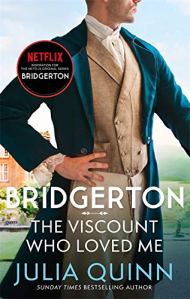
The second book, ‘The Viscount Who Loved Me’ was also released in 2000. It establishes a stark contrast between the Anthony Bridgerton we meet in the first book, who is devoted to his siblings and would never allow them to be dishonoured, to a lecherous rake who doesn’t care that the women he’s sleeping with probably have families like he does. You get to see the other side of the sexism that hung over Daphne’s story through the eyes of Anthony and his love interest, Kate.
I loved Kate’s character in this story. She was fierce, funny and had a lot of personality, which is implied to be because she and her sister Edwina weren’t from the same High Society world that the Bridgertons, Featheringtons, Smythe-Smiths etc. are from.
I also liked seeing how delusional and erratic Anthony was due to the trauma he experienced. He went absolutely insane when Kate was stung by a bee, and despite the fact that of the two of them, Anthony was the one more likely to be allergic to bees, he still risked killing himself to avoid it killing Kate. It was heroism in his mind and farcical in hers. I wanted to throw the book across the room because it seemed so ridiculous. A bee: the thing that killed his father, would be what forced his hand and let him marry the girl he was pining for. If only other romance books had a bee sting subplot to expedite the romance!
Unlike the first book which dips into a regency era fake-dating scheme, Anthony’s love story explores the rivals to lovers trope.
By the time I’d read Anthony’s book, there were already aspects of these books that were annoying me, not enough to stop reading the series, especially since friends were begging me to join them in their obsession, but enough to be somewhat exasperated. In both Anthony and Daphne’s respective books, a wedding had to be thrust upon them after some scandalous behaviour took place that risked dishonouring Daphne and Kate respectively. And when Daphne and Kate were introduced to the idea of sexual intimacy and satisfying your husband, the whole scene is basically copied and pasted. Like, what do you mean I have to read this awkward conversation twice!
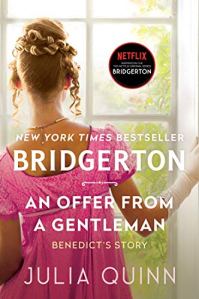
I was grateful for the breath of fresh air that was Benedict’s story. ‘An Offer From A Gentleman’, which was released in 2001,was a regency era Cinderella story.
I loved Sophie’s character, and even though this whole story seemed very obvious, and inevitable, I loved Sophie’s inner dilemma over whether to confess that she was the mystery woman from his mother’s masquerade, that haunted Benedict through the years.
I was surprised by Benedict’s character in this book. He had his own insecurities which made total sense, but he was so forward and brazen. Imagine soliciting a pretty girl you saved from sexual assault to be your mistress! Like, Sir, do you hear yourself?
Like the previous books, it was a quick and easy read, though it was my knowledge of what was coming next that spurred me on. Of all the Bridgerton books thus far, I declared this would be the one I wouldn’t be eagerly rereading it. Not at all. I just wanted to finish it to see Colin’s cameo and rude comment about Penelope force his hand. They’d been friends. They’d been kind. She’d been in love with him from the start. I wanted consequences and I wanted them immediately. So, of course, I ploughed through the farce that was Sophie being threatened to go to the gallows for her theft when she ran away from her abusive family.
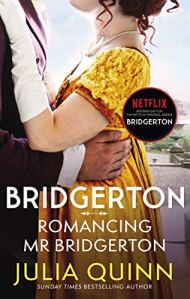
Then there was ‘Romancing Mister Bridgerton’, which was released in the following year, in 2002. Now this book? This book was what I wanted! Give me that friends to lovers! Give me that betrayal on betrayal on betrayal and give me it now! Unlike the show, where the identity of Lady Whistledown was known, there were only speculations in the series thus far. This was when the readers found out and suddenly everything made sense. Of course it was the wallflower!
I loved how the primary focus of the summer season, which had been drole and unexciting was Lady Danbury’s bet, where she said she would give whoever exposed the infamous Lady Whisteledown a whopping £1000, which is according to Google, would be about £119,000 in today’s money. This whole overarching plotline in which Lady Whistledown was to be exposed added room for the readers to speculate.
There were so many amazing elements in this book. I adored Penelope’s relationship with Lady Danbury. She was still in love with Colin even after he hurt her so badly in the previous book. But, she has consigned herself to spinsterhood, and accepted she will just have to eke out a sad existence under her mother’s thumb. And it’s sad! You get to see how Lady Featherington is and she is not a nice woman! I likened it to a reality Sophie would have relished before marrying Benedict.
But there was more! So much more to love! Unlike the first books where the thing that clearly united the Bridgertons and their love interests was sexual attraction, Colin and Penelope laid a strong foundation. They had tonnes of things in common. I loved it! I loved that they were both writers – especially since, as a writer myself, I could relate to Penelope’s pride, but also Colin’s insecurities. I wanted them to succeed,
And, it did help, of course, that readers knew they were endgame from the epilogue of ‘The Duke And I’! I read the books in between hoping to get some more glimpses into Colin and Penelope’s happy, married life.
I loved this book! This one was by far my favourite! I loathed how Penelope was treated by her family, and how she had been completely ignored by them and overlooked as a potential spouse for Colin. Watching him stand up for her was just glorious! I loved it! After what he did, he needed to beg on his knees for forgiveness, and prove himself worthy of her attention, let alone her affection! And he demonstrated so much growth and honesty and vulnerability in his story that I felt bad for him! Even if he had been so cruel in the past! Penelope deserved better so he became better! I loved that for them!
Though, I must say, that Violet Bridgerton must have been losing her mind. It was a miracle that this beloved family hadn’t been cast into social ruin after not one, not two, not three, but four rush weddings! Eight kids, and yet there had been four rush weddings! Four out of five! Where is the scandal, Violet? What leverage do you have over the rest of society?
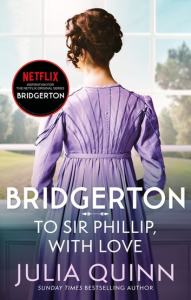
Book five, Eloise’s story, ‘Dear Sir Philip, With Love’ came out in 2003, and explores the days following Colin and Penelope’s announcement at the end of ‘Romancing Mister Bridgerton’, an announcement that Eloise missed entirely, as she was already in a carriage to Gloucestershire.
But why? As Colin speculated in the previous novel, it is clear that Eloise is incredibly dedicated to her correspondence. She has a pen-pal whom she writes to frequently, all of which was spurred on by her expressing her condolences upon the death of her fourth cousin, Marina Crane. Sir Phillip Crane’s wife, and the mother of his children.
After Colin and Penelope were wed, Eloise acknowledged that perhaps she didn’t want to be a spinster, not without the company of her best friend, Penelope. So when the man she’d been writing to for a year, proposed they meet and court one another, with marriage in mind, she decided to take her fate by the reigns and leave for Gloucestershire, when nobody could stop her. But her daydreams aren’t as true to life as she’d hope, and with her scandalous decision to escape and make the decision for herself, her reputation is at risk.
I loved this book. Like the pervious stories, it truly offers another dimension to the dynamic among the Bridgerton siblings, and how despite their guns-blazing attitude about rectifying what had happened, it is once again clear why this family is so endearing to readers. The way Quinn manages to write easy, casual interactions between the siblings is incredibly compelling. I could relate to how causal and silly they were, but also how true, honest and supportive they were. It offered more perspective, particularly into the older brothers and their respective senses of obligation to their younger siblings. And, of course, our first real look at the young rake that would be Gregory Bridgerton. I loved it. It was one of my favourites of the series.
Furthermore, in the absence of Lady Whistledown’s Society Papers, instead there were snippets of Eloise’s correspondence, which really offered some much0needed perspective into her extended relationships, especially since Eloise and Kate, for example, hadn’t explicitly interacted since the second book in the series. It shows her rapport and her keen penmanship, and of course, Eloise’s inability to shut up. It really showcased her personality and was a great addition.
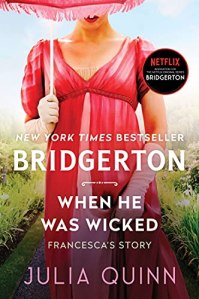
The sixth Bridgerton novel, ‘When He Was Wicked’ was released in 2004. It follows Francesca, the widowed Countess of Kilmartin, as she embarks on her first season back on the marriage mart, four years after the death of her husband, John, a miscarriage, and the unprecedented departure of the new Earl of Kilmartin, John’s cousin, and best friend, Michael.
It is set during the same window in 1824, in which ‘Romancing Mister Bridgerton’ and ‘To Sir Phillip, With Love’ were st, with events overlapping throughout, demonstrating how removed Francesca feels from the rest of her family unit.
Unlike the other stories thus far, readers are offered insight into how widows are perceived in society, especially when they’re reasonably young. Unlike Penelope and Eloise, who are twenty-eight years old and considered spinsters, Francesca’s marriage to the late earl offers her the opportunity to make a second debut into society, having shunned the greys, blacks and lavenders of regency mourning attire.
Michael, who fled Scotland and his grief to process his loss, spent four years in India, and had also returned to Britain, likely to wed. But, the issue at hand is that he’s been in love with Francesca since they met. While certain people can see through Michael’s facade, Francesca is none-the-wiser, and thus begins a messy attempt of courtship with other people, and when in a heated exchange, Michael and Francesca kiss, there is little they can do but succumb to their desire.
This book offers insight into wider societal issues, such as the difference in how society acknowlegded women of different ages and statuses in society. Despite being spinsters, Penelope and Eloise were expected to be chaperoned when they went out, but Francesca could roam wherever she wished, because she was of a different ilk. Disgustingly, as one of the patrons of the club the Bridgertons attended, said that Francesca, a young widow, for widow’s standards, was like “having a virgin that knew what she was doing”. The misogyny was rampant, and made me feel incredibly bad for Francesca.
Then there was the theme of infertility, I almost wish that the book had gone a bit deeper into Francesca’s insecurities about having miscarried after two years with John, and struggling to conceive from then onward. Though, I did like, though implied, that first, Francesca blamed John in part for her struggle to get pregnant, but when she and Michael started sleeping together, she still didn’t get pregnant. It offered a sense of perspective that although society wasn’t necessarily at the point where a man could or would acknowledge their inability to impregnate their spouse, the women weren’t so sure. After all, as Michael so eloquently put it, the Bridgerton family had a huge brood, and an even greater number of grandchildren as the years ticked on. Perhaps it was never a fertility issue on the Bridgerton side of the family at all, since John and Michael appeared to both be only children. There’s a lot of room to infer, but I would have loved some more concrete content there.
I’d argue that of the six books I’d read thus far, reading ‘When He Was Wicked’ was probably the story was more desire-driven than anything, which wasn’t a bad thing, but it wasn’t my favourite of the series.
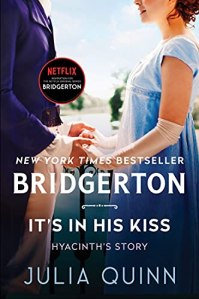
The next book of the series, follows the youngest of the Bridgerton brood, Hyacinth. ‘It’s In His Kiss’ was released in 2006.
‘In His Kiss’ follows the youngest of the four Bridgerton daughters and the youngest Bridgerton child, Hyacinth, who at twenty two years old, is entering her fourth season in the marriage mart. She is bored. And although her life is good and she enjoys her routine of going to read romance novels to Lady Danbury every Tuesday and taking tea with her mother, she wants more.
From the first book in the series, Hyacinth has been made out to be a huge personality. She’s bawdy and confident and witty. Her intellect shines purposefully and her siblings adore her. They also fear her, rightly so, as we soon learn. She is notorious and a bit of a marmite figure among society, people either liking or loathing her due to the way she carries herself. She likens herself to the notorious Lady Danbury, and wouldn’t mind growing up to be just like her.
It’s lovely to see Lady Danbury held in such high esteem. I love her character. And so, who would be better suited as a match for Hyacinth than Lady Danbury’s grandson, Gareth St Clair. Heir to the St Clair Barony.
Personally, I found this book far more interesting than most of the books in the series thus far. Unlike her siblings, Hyacinth isn’t actively looking for a husband when she ends up caught up in her own spectacular love story. There is a large overarching mystery oriented plot that looms over her romance with Gareth St Clair. I found that having something to focus on which wasn’t the banes of being a servant girl and mithered to be a mistress, or coping with your best friend and your older brother finding love was much more entertaining because it was something new. In a way, having a non-romantic plot to focus on, just like the bet Lady Danbury made in ‘Romancing Mister Bridgerton’ meant that we could see the romance blossom on its own in a more natural and modern manner, outside of regency courtship conventions.
There was a lot more risk involved this time around. Usually when characters have been in compromising positions it was because they succumbed to their desire, but this time the espionage was what could cause Hyacinth’s social ruin, and force her to marry Gareth St Clair, before she was willing to admit she wouldn’t mind that at all. Nor was there that same looming fear of her own desires. It was refreshing to see that Hyacinth would ruin herself in a manner as unique as she is. It would not be down to the fact she was had had sex with her fiancé before their wedding date. It was a great change of pace and I was immensely grateful for it.
I loved how passionately in love Gareth was with Hyacinth and how willing he was to express it. I was so giddy, squealing and kicking my legs when he realised he didn’t want to be without her and rushed to Bridgerton House to ask Anthony for her hand. It was a great way to show the ‘she fell first but he fell harder’ trope that didn’t need the pre-existing pining that was essential for Colin and Penelope’s love story.
Though, I must admit, I didn’t like Anthony’s reaction. Funny as it was. Yes it made sense for his character, no longer needing to be a father to his siblings, his obligations as the man of the family having been completed, or at least until his three-year-old daughter is of age, but it felt like a disservice to Hyacinth. We learned Hyacinth never consciously regarded Anthony as a father figure in her life, though she loved him dearly, so seeing the friction between how Anthony has had to behave for the good of his siblings and the lack of acknowledgement from Hyacinth certainly shows how Hyacinth perceives her reality. After all, she never knew her father. She only knew the role Anthony was honing in her infancy, the good role model, the shoulder to cry on, the respectable man of the house, etc.
Not that my feeling that Anthony’s relief was perhaps a bit too much of a dig to Hyacinth stopped me from loving this book. It was ultimately one of my favourites!

‘On The Way To The Wedding’ is the last book of the Bridgerton Series and was released in 2006. It follows the only remaining unmarried Bridgerton of the first generation, Gregory.
Gregory’s story starts with a dramatic wedding crashing moment. He has run what is supposed to feel like half the length of London, up the steps and into the church, only to propose to the bride at the altar.
He is certainly a character that makes an impression.
After such a grandiose beginning, I found the passing to be a bit here-and-there, desperate to lull through the exposition and het to the meat and potatoes of his story, and hear how he fell so spectacularly in love with a woman that he professed his love to her in front of pews filled with onlookers. It was an incredibly compelling motivation, even when I didn’t care much about what was going on.
Admittedly, the same opening sequence that had me instantly ready to dive straight in, made me incredibly disinterested in anything that didn’t have to do with Gregory and Lucy. Unlike people who hadn’t been privy to the second epilogues, I knew that Gregory wouldn’t end up with the first object of his affections, Hermione, and was just glad that that was over and done with. I wasn’t attached to her at all. I didn’t care when she was caught in a compromising position with Richard. I just wanted to get to the point. I am a sucker for immediate gratification, after all.
I really did like Gregory’s book though. The latter end of it was so dramatic and filled with grandiose gestures to demonstrate the length of each character’s love and devotion to one another that it was equally funny and endearing to see Gregory break into the wedding reception for answers’ sake. It made sense. Though, the way the last chapter closed things off really did feel like Quinn was just wrapping it up in a bow and shunning politics under the power of money and influence, especially when mentioning the ranks of people who were in favour of Gregory’s marriage to Lucy.
Overall, I liked the series. I had my favourite books, of course. My favourite, for example, was Colin and Penelope’s love story in ‘Romancing Mister Bridgerton’., followed closely by Hyacinth and Gareth’s love story in ‘It’s In His Kiss’. But, across the board, some things were just consistently brilliant.
For example, the way Quinn offered individual insights into the relationships and closeness that the characters have with their siblings, and how that dynamic changes depending on who is around. For example, Anthony would have killed anyone who dared besmirch his sisters’ honour, as demonstrated in some of the books, but he was also a responsible level-headed man who acted more like a father figure to his siblings and evidently would have rather been a big brother. I also loved how these family relationships shift and change as time goes on, and more people marry into the family. The men and women in the extended family unit get on incredibly well, as a family should, and their rapport is demonstrated through their dialogue, across all eight books.
I found elements of the eight books rather monotonous. For example, the pathetic fallacy seemed impossible to ignore, because it was a formulaic intrinsic part of Quinn’s storytelling. I would have loved some more juxtaposing weather. After all, in the real world, sunny days aren’t inherently good omens.
Then there were the marriage rites and expectations among the characters. I was incredibly grateful that by the third book, there were no longer conversations about how women ought to please their husbands sexually. It was an awkward conversation, that certainly didn’t need to be that long, when a simple declaration that that was what they’d spoken about would have gotten the point across.
I found that by far, my favourite character was Lady Danbury. I absolutely adored her, and any books where she is in the spotlight were easy favourites of mine. The rapport she established with Penelope was incredibly comforting, and necessary to allow the shy spinster to finally speak her mind. Lady Danbury and Penelope had a lot in common, such as their consistent attendance at the annual Smythe-Smith musicale, to support the obligatory Smythe-Smith girl that felt incredibly ashamed to be on the stage, performing badly for their peers. Meanwhile, Lady Danbury’s relationship with Hyacinth is far more rooted in comradery, seeing each other as mirrors of one another. Their banter shows their rapport and understanding, and I hope one day Lady Danbury’s life gets a book of its own. After all, the concept of regency era romance and the different families mean Quinn has a vast pool of potential relationships to explore, sich as her series about the Smythe-Smiths, or the stand alone novel ‘Queen Charlotte’!
The series was a fun, enjoyable collection of romance novels that catered to a vast number of trope-based-preferences. There was something for everyone, and I enjoyed sampling the sheer scope of chaos one family could inspire without ruin or scandal. I really enjoyed it, and would recommend the series to anyone who wants a fun regency
 Imogen L. Smiley