
Book Review: The Ballad Of Songbirds And Snakes by Suzanne Collins
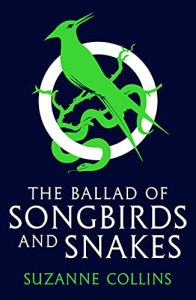
‘The Ballad Of Songbirds And Snakes’ by Suzanne Collins was released in 2020. The book is a prequel to her series ‘The Hunger Games’, the original trilogy came out between 2008 and 2010. This book follows the early life of President Snow, and the story of when he was a mentor in the tenth annual Hunger Games, and the film adaptation was recently released, too.
This book is set ten years after the end of the Dark Days, and the war. Coriolanus Snow, an eighteen-year-old man is living in poverty, and both the Districts and the Capitol are struggling to recover from the war, even a decade later, both from a governing perspective and a resource perspective. The Capitol lacks the control and power that is shown in Katniss Everdeen’s story 64 years later.
Coriolanus Snow lives in a penthouse apartment with his Grandma’am and his cousin, Tigris, they are struggling to feed themselves, and are facing eviction. They’re destitute, and the only way for the family to escape poverty is for Coriolanus to sucessfully win one of the illusive prizes that will be given to stand-out students at his school, The Academy, where twenty-four of the top students would have the role of mentoring the tributes going into The Hunger Games.
Coriolanus ends up with, theoretically, the worst tribute to draw, the female tribute from District Twelve: one Lucy Grey Baird, whom he quickly bonds with. With the promise of money and helping ease the burden on his family, Coriolanus does everything he can to ensure Lucy Grey wins the Games.
‘The Ballad of Songbirds And Snakes’ provides readers with a sense of understanding about the extent to which Coriolanus Snow actually influenced the way Capitol society and The Hunger Games work. His passing comments, his active propositions and suggestions offered up to Head Gamemaker, Dr Gaul, and the things he observes throughout the games simply don’t occur in Katniss’ story. This is implied to be because of him acquiring enough power and influence to make those changes in the Games, in the Capitol and in the Districts.
Another element of this book I absolutely adored was the character of Sejanus Plinth. Sejanus hailed from District Two, and while his family were able to climb socially from Two due to their lucky investments, the Snow fortune had been invested in District Thirteen, thus leading to the Snow family’s downfall. Sejanus is Coriolanus’ foil. Where Snow is detatched from the suffering of the people of the Districts, Sejanus cannot seperate himself from the people he left behind. So, when he is forced to mentor his former classmate from District Two, Marcus, Sejanus cannot handle the turmoil and emotional reckoning that comes from it. There were many times I considered it likely that Sejanus could, and would be made into an Avox. He has a stubborn sense of right and wrong, and honours his roots, upkeeping traditions, like sprinkling breadcrumbs on the deceased to ensure they have sustenance for when they travel to the next life. I loved Sejanus. He demonstrated the extent to which even just ten years after the Dark Days had concluded, the self-righteousness that the Capitol wielded had been thrust onto the children, now young adults and the future leaders of Panem.
I loved how this book demonstrated that the person Snow considers a bane to his existence, ends up haunting him. No matter where he goes, he is reminded of his shortcomings and will be for the rest of his life. From the way that this book revels that his tribute and his victor, Lucy Grey, wrote ‘The Hanging Tree’, the song Katniss sings to Pollux, and the mockingjays mimic in the final book of the original Hunger Games trilogy, to the way that high society among the Capitol elite is drenched in nepotism. For example, Aracne and Seneca Crane, both of whom get their comeuppance by focusing on entertainment over the actual meaning of The Hunger Games.
I would love to read more of Suzanne Collins’ books about The Hunger Games and figures from Katniss’ story, and their respective backstories, like Finnick Odair, Annie Cresta, Johanna Mason or at the very least, the only other District Twelve Victor, whose story we know but we don’t, Haymitch Abernathy. The way Collins writes the fraying morality that comes from being stripped of everything you have and need and want, and are thrown into a life-or-death scenario is just as harrowing as it was the first time around. She has a masterful control over the way her world and her words make the audience feel and I wish I could reread the whole series from front-to-back for the first time again.
 Imogen L. Smiley