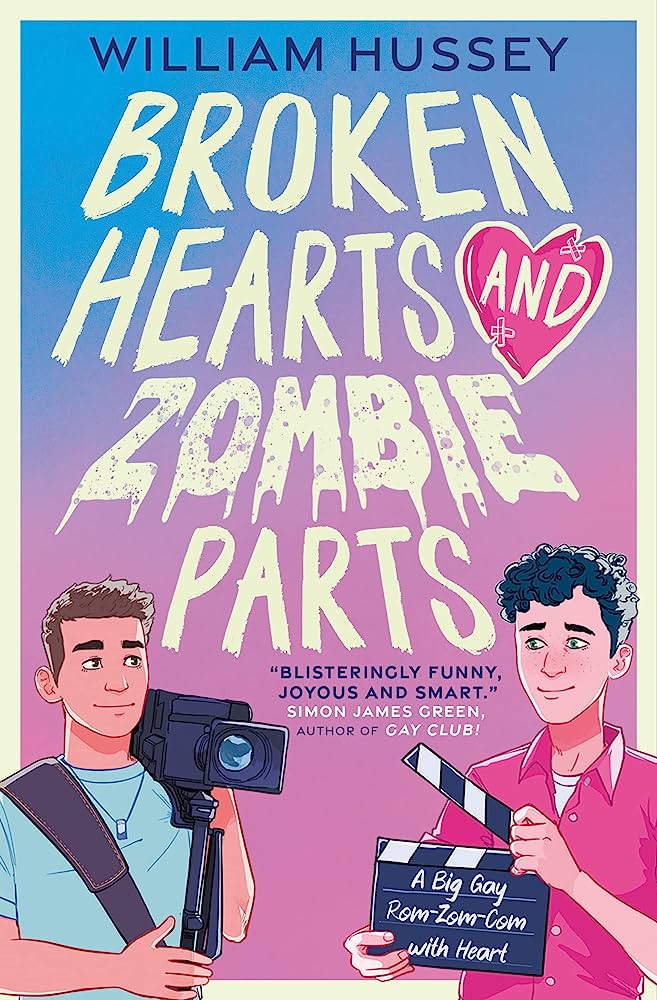
Book Review: Broken Hearts and Zombie Parts by William Hussey
‘Broken Hearts and Zombie Parts’ by William Hussey was released in 2023. It was his eleventh novel. It follows seventeen-year-old Jesse, who collapsed at his Year Twelve Prom, after encountering his best friend, Cas, cheating on his girlfriend, with her best friend. After collapsing, he is informed he will need open heart surgery in order to correct a genetic fault with his heart, which will leave him with a large scar on his chest. A scar, which Jesse thinks, will render him unattractive and unlovable.
He therefore, decides to try and achieve two things before he goes under the knife: make his feature-film ‘Zombie Honeymoon’, and have a summer romance before he is scarred by his surgery.
There are so many things that I loved about this book. However, the things that rubbed me the wrong way, had me seriously considering DNF-ing the whole book. I continued, because I had faith in the power of a reasonably neat and tidy resolution.
Let’s start with what I adored – for one, the character voice. Jesse is an incredibly biased and unreliable narrator and his word-vomit and rambling nature made him very likeable from the get go. I absolutely loved him, and related to him, and the way characters interact with him, such as Doctor Myers asking his mother is Jesse is usually as long-winded, etc. and her confirming that is just how he is, that Doctor Myers simply, bluntly, and hilariously remarks that she has his sympathies. Jesse was a great character. The anecdote about his naivety and obliviousness, which involved a whole bag of birdseed and some ducks had me in stitches.
Then there was how Hussey managed to navigate the scope of the themes of body confidence, through multiple lenses. You see a variety of different characters throughout the book navigating insecurities, but two of the most prominent are Jesse and his best friend Morgan, who both struggle with low self-esteem. Morgan’s family are champions of health and fitness and shame her for enjoying food, and being plus-sized when they have a sportswear brand and a chain of gyms in their family empire. Meanwhile Jesse is scared the scar left from his surgery will render him completely unlovable. He echoes Morgan’s thoughts but it takes a while for him to admit to his own insecurity. The way the characters move to improve their self-esteem is through communication, not diets, etc. It was lovely to see Morgan’s emotional outburst at the end of the book subsequently causing empowering conversations that encouraged a variety of characters to be kinder to themselves.
Another element of this book that I adored was how, in many ways it was a love letter to the creative industries. It highlighted the joys of being an artist, a creative, and how coming together with likeminded people inspired community. I loved seeing Cas and Jesse interact and discuss the film, and how Louis and Jesse shared such a passion for storytelling, especially as a writer myself. Being able to write your ideas and make them accessible to others is a craft, and I loved seeing how each person’s skills helped make ‘Zombie Honeymoon’ something amazing, even side characters with little to no dialogue, like Stan The Can Man, the sound technician, and Caleb, lead singer of a local up-and-coming band. Then there’s Tiny, who had big dreams of superstardom, and became the butt of Jesse and Cas’ jokes, which would have, as we later learned, broken Tiny’s heart. All of this was so empowering, especially in a world which is constantly disparaging artists and creative industries, devaluing degrees in arts, etc.
Which meant seeing how a character’s decision to write what they know in an attempt to create a compelling one-man-show in a bid to get into drama school had me mortified. There’s such thing as writing about subjects that are too close to home, and in the arts, where so many things are up to interpretation, there is a lot of grey area to mull through when navigating hard-hitting topics. Especially when it isn’t your story to tell. There’s a difference between reflecting on lived experience, and immersing yourself in a place you don’t need to be, and being offensive in the process.
Another thing that I really liked was the side characters. I’ve already mentioned Tiny, who was amazing, but the character I didn’t expect to care so much about was Dean, Cas’ older brother. Cas’ family have a lot of problems. Dean is ten years Cas’ senior and the sole benefactor for their family. Dean was supposedly unlikeable, navigating the conflict between hegemonic masculinity, bravado, machismo, the family finances, his own trauma and struggles, his grandma’s illness, his younger brother’s idol worship, and internalised homophobia, whilst providing for them, and their ailing Nanna Laura, who has dementia. Dean is evidently incredibly smooth, confident, sly and influential. The first indicator we get about his character comes from a passing comment Jesse’s mother gives about him flirting with her in the supermarket. Even with his issues, constant jabs and jibes about Jesse’s sexuality, he is, evidently not as nasty of a person as Jesse makes out. He loves his family fiercely.
Dean is actually why I had such issue with one of the plot points in this book. In a bid to secure high-quality film equipment for the film, Cas, Jesse, Dean, Morgan and make-up artist Roisin, end up involved in a heist of the sixth form, where Cas and Dean break into the film department and steal thousands of pounds worth of equipment, which their teacher said they couldn’t use, because it would cost him his job. If they were caught, surely, they’d be arrested, tried, etc. and with Dean being an adult with a fully developed frontal lobe etc. you would assume he would have discouraged theft. Especially as the sole provider for him, Cas, and Nanna Laura. But no. He goes along with it to make his brother happy. He goes along with it, and his fierce supportive, brotherly nature has it implied he’d take the fall if they were caught. I spent the whole book terrified that Dean would be arrested. Call it my over-empathetic heart, but I considered the whole scheme so implausible that I considered dropping the story then and there. The only reason I carried on was because I had heard good things about the story. But it took a lot of effort to continue on. It really skewed my perception of Cas, and diverted my attention from other plot elements because I was so worried that Cas and Nanna Laura would be left without anyone there for them.
The resolution of that whole saga was also incredibly convenient for me. I would have much rather, much, much rather them get away with it, and sneak the equipment back into school on Results Day than what actually happened. The lack of concrete consequence irked me immensely.
I would recommend this book none-the-less, simply due to the questions it poses about writing what you know, and the arts. But, of course, if endings that feel a bit too contrived, especially when it involves the police, rub you the wrong way, I’d suggest reading something else. I don’t regret picking up this book, and ultimately, having finished it, qualms aside, I do reckon I’d have regretted not finishing it, knowing what I know, of course. It wasn’t my favourite read – but who knows, maybe it’ll be yours!
 Imogen L. Smiley