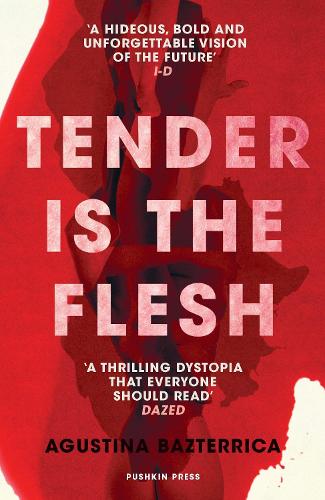
Book Review: Tender Is The Flesh by Augustina Bazterrica
‘Tender Is The Flesh’ by Augustina Bazterrica was originally published in Spanish in 2017. Pushkin Press released an English translated edition, with a translation provided by Sarah Moses in 2020.
This novel was completely disgusting, and harrowing. I loved getting to see the implications of this world-changing virus, released in a pre-covid world, where the root cause is animal consumption. When I first heard the concept for this novel, I knew I had to read it, but I didn’t even consider the depth of the scope of the worldbuilding.
The idea of animals being able to infect humans with this virus, the details of which are never actually offered up, was very interesting. I never considered that in needing to eradicate the virus, any sense of domestication or conservation was swept away. I thought it would simply destroy the farming industry. The idea of needing to kill your pets lest their pathogens kill you broke my heart. I had to put the book down dozens of times to hug my dogs. It made me want to change my habits radically, and just curl up hugging my dogs until the end of days. An economical solution to this theoretical scenario, of course.
I felt a lot of empathy toward Marcos, he was a sympathetic figure, who didn’t mesh with this new world, and was depicted as a figure that was resisting accepting The Transition, from eating traditional farm animals like pigs, cows or chickens, to consuming human meat. As a man who worked in the farming sector in the past, dealing with the change in seeing humans as livestock but also as your colleagues and neighbours was distressing and so, he has a lot of walls up. I found his character incredibly complex – he doesn’t want to be eaten, nor would he wish that fate upon his father, sister, niece, nephew, wife, or anyone else.
I found the idea of FGPs – First Generation Pures, incredibly fascinating and well thought out, as they indicated a sense of how long this virus had impacted the world. For a FGP to be in her early twenties, that meant that the virus would have had to have happened for that long. That’s because, as Bazterrica goes to lengths to explain, unlike many of the humans whose meat was consumed, FGPs were not given injections to accelerate their growth rate to deal with supply and demand. FGPs were raised from infancy for their entire lives to be eaten, and thus, were considered higher quality produce because they took longer to raise. Like wine or cheese that has fermented. This was some incredibly clever worldbuilding.
This story showed a lot of depth and complexity within the human psyche and what people could and could not reject as they went forward attempting to survive the new normal. This was certainly an impactful read, having read it after the pandemic. The way that Marcos stifled his grief for his pets, Koko and Pugliese, and his son, Leo, in order to continue on, and keep his father, who had suffered a breakdown amidst The Transition and was suffering with dementia, in a care facility that wouldn’t kill him off prematurely and sell his body parts on the Black Market.
The idea of the farming industry trying to reduce the humans who were held captive for slaughter to a borderline animal-like state, by removing their vocal-chords, feeding them from bowls, and refusing to clothe them, or name them, left me nauseous. Especially because, when Jasmine ends up in Marcos’ life, and her subsequent pregnancy there are so many deeper, moral questions to pose.
What would you be willing to do to survive? What would you be willing to do to ensure obedience? If you could give your spouse the one thing she wants, would you do it? And would you allow yourself to be selfish in the face of death? I don’t think I could answer those questions, nor do I think I’d honour them if I actually was in Marcos’ shoes. The whole book was poignant and evocative. I thoroughly recommend it.
The whole novel was incredibly complex, and distressing. I kept needing to take breaks in order to carry on. It offers so many points to ponder, and a broad scope of what we as human beings deem acceptable and what we don’t. I would thoroughly recommend it, especially for lovers of dystopia, or books that leave you questioning your own existence.
 Imogen L. Smiley