Book Review: Straight Expectations by Calum McSwiggan
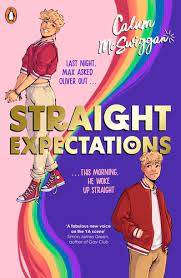
‘Straight Expectations’ by Calum McSwiggan is a romantic comedy that was released in May 2023. It offers an insightful glimpse into privilege, and how, even though things may be objectively easier for straight kids at school, Max, is still privileged. When he, an out-and-proud gay, wishes for an easy life like the straight kids, he wakes up straight!
‘Straight Expectations’ is an incredibly witty name, for one, and provides a much-needed commentary on toxic masculinity, and the scope of privilege, how different privleges impact your life, and how ignorant you may be of others’ struggles due to your privilege being like a pair of rose-tinted glasses. Which is certainly the way it is for Max Baker.
His parents are divorced, but he has a substantial household income, enough that his parents are willing to fund an entire gap year of international travel so Max can work out what he wants to do with his life. Meanwhile, his best friends don’t have these opportunities. Dean Jackson is black, and lives with his single mother on a local estate that developers have wanted to knock down for years, he dreams of the glow of the spotlight, and sold-out theatres on the West End. Alicia is a dreamer too, and works constantly on her portfolio to get into a degree in the arts. Unlike her best friends, she is straight and is a fierce ally to the LGBTQ+ community. But, even she is knocked down a peg by racial inequality.
The original consensus and dynamic of the story is that Max, Dean, Alicia, and other members of the Woodside Academy Queer Club experience a clear us-versus-them mentality. It is apparent that they are disliked due to clashes with some authority figures’ and their personal beliefs. But, Max is secure in himself, his identity, his gender presentation and style, and is confident that people have his back including the Drama teacher, Mrs A. who is out at work as a lesbian, and provides that sense of comfort and reassurance to the children she teaches. At the start of the book, in anticipation of the school production of ‘Little Shop Of Horrors’, and after working on the staging and sets, Alicia inadvertently sends a spattered trail of paint from the door to the drama department, all the way to the Sixth Form common room, where the Queer Club meet, and are met with the furious Mr. Johnson, who manages to ruffle the feathers of everyone in the room in a matter of four pages. It was infuriating as a reader to see an authority figure, in charge of children, spout so many passive-aggressive comments: from commenting on Dean and Max’s nail polish to telling Alicia, who has her hair in box braids that he loves the new hair as an afterthought after giving her detention. Detention: for Max calling him a prick, because that was definitely Alicia’s fault.
Furthermore, its clear that Mr. Johnson is an antagonistic force in the book, because, after giving Max, Dean and Alicia detention over a few droplets of paint, he has the gall, the nerve, the audacity and the gumption to turn to Dean, a seventeen-year-old boy: “you really think you own the place, don’t you, Jackson? I certainly hope you have a plan for when you leave school. I think you’ll find the world to be quite a different place for the likes of you”, which is obviously a double entendre, talking about how Dean stood up to an authority figure and the fact he is going to grow up to be a queer black man in an awfully homophobic, racist world. And when Dean demands to know what he means, he declares that he’s a “big fish in a little pond”. Oh my goodness, I wanted to slap him. McSwiggan made the antagonist of this small rural school an absolute piece of work.
I really wanted to punch him. Hell, typing up that passage, even after finishing the book, still made me want to punch him.
It isn’t long after Alicia and Dean are praised in the local paper for their work on an amazing opening night of Little Shop Of Horrors, that the group get together for a sleepover at Alicia’s house, and what starts as a lament about what’s going awry in Max’s life spirals into a commentary about how he envies his friends and their lives, and wishes he could be like the straight kids, even for just a few days. It was an insane overreaction on Max’s part, as its clear he really doesn’t understand the nuance of his words, or the implications of having less privilege than he does. And instead of using it for the good of his friends, he throws it in their faces. They attempt to check him, and put him in line but fail miserably. And, after making his ridiculous wish, Max storms out of Alicia’s and wakes up in a different world, that is so similar to his, but so incredibly different. Most startingly – his parents are still together, Ollie is calling Max his best friend, and apparently he’s straight!
Max quickly makes the distinction between his world, and this one, unceremoniously dubbing them Straightworld and Gayworld. The estate where Dean and his mother Marcy live has been torn down, Dean is completely untraceable, and his crush, whom he’d just asked out at Alicia’s house before everything blew up in his face, is apparently now his gay best friend. While Max’s body is very much unattracted to boys, his conscious mind still is, which makes him hyper-aware of how strange everything is. A true ode to ‘Freaky Friday’, ironically one of Max’s favourite films. It provides a great opportunity for hilarious commentary, wit and huge mistakes to be made. Like rejecting Alicia when she solicits sex from him, because he doesn’t love her like that, despite apparently being in a relationship with her for however long. He breaks hearts, hurts people and doesn’t know how to cease the destruction in his wake.
After a supposed epiphany at Ollie’s house, where he declares a kiss from Prince Charming may fix what went wrong, he decides to be authentically himself, or at least, the version of him he knows himself to be, and is immediately scrutinised for his audacity. By none other than Mr Johnson.
Unfortunately for Max, Mr Johnson goes unchecked in the workplace and is even worse than he was before. When Max decides to express himself, and customise his clothing, wear something he would have worn in GayWorld, Mr Johnson attempts to send him home for violating the dress code, and due to not having batted heads with Dean in StraightWorld, Mr Johnson somehow has even more audacity – declaring Max’s attire is “clown gettup” and that Ollie’s rainbow shoelaces are something that he needs to “turn a blind eye” to. It was truly outrageous, because, in GayWorld, Ollie looks up to Mr Johnson to an extent, after all, he’s his football coach! To think that GayWorld and StraightWorld are parallels to each other means these are likely comments and thoughts that Mr Johnson has had about Ollie’s shoelaces in GayWorld, too. The dramatic irony of the bigotry truly being indiscriminate to his favourites, as Ollie and his best friend Thomas perceives them to be, is really heartbreaking.
I loved the ending, where Max has his ‘Freaky Friday’ conclusion moment, and has to face up to his actions, and offer Alicia, and Dean apologies, regardless of whether they know him, understand him, want to listen to him, or not. And when he returns to his version of reality, he still has a lot to make up for. And it takes some grafting to make sure his apologies are felt, and understood. He has to make changes.
The conclusion of the book was incredibly rewarding. I wished that Mr Johnson would get his comeuppance, but, truly, what made this book feel real-er was that he didn’t. because bigots often don’t get their comeuppance immediately, something has to happen to shatter that worldview, something has to happen to make him think again. Something that’s not as subtle as racial microaggressions and being rude to Dean, would need to instigate a change like him being fired. It’s sad. Really sad.
Despite this, I cannot even begin to tell you how funny this book is. Despite the hard-hitting commentary, it offers scathing, cut-throat humour that pokes fun out of queer experiences in a way queer people understand and is clearly not written with an explicit straight-gaze audience. It was fun. I can’t count how many times I was in stitches about what the characters said, did, or thought. McSwiggan has a great sense of character voice and it really is fantastic. I’d recommend it without a second thought.
 Imogen L. Smiley