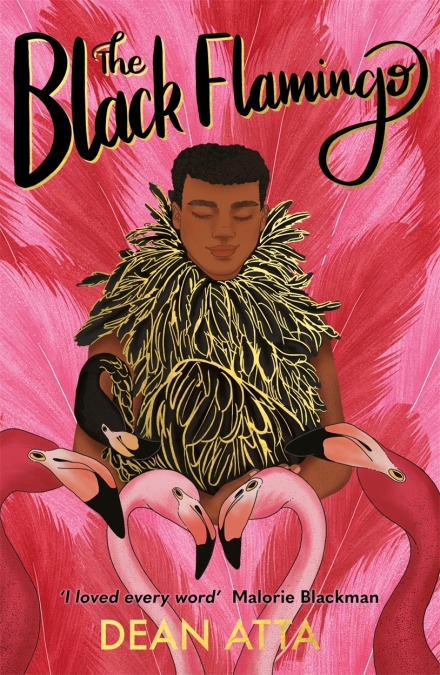
Book Review: The Black Flamingo by Dean Atta
Dean Atta’s debut novel in verse, ‘The Black Flamingo’ was released in 2019. It tells the story of Michael Angeli from childhood through to the Christmas after he turned nineteen.
Michael’s story focuses on a sense of belonging and identity, not feeling like he necessarily fits in among his peers, or the different pieces of his family unit. Michael and his sister Anna are raised by a single mother, with different fathers that have contrasting depths of involvement with their children. Anna’s father, Trevor, was around when Michael was young, and still makes contact with his daughter – while the closest thing Michael has to a father is his Uncle B, his father’s brother, who buys him extravagant gifts like a telescope.
I really liked how Atta dissected the themes of identity, and disconnect, through Michael but also his friend, Daisy. Michael encounters friction with Daisy, wondering whether her blunt, and often scathing comments on her race, her preferences etc. is inherently racist because she is mixed-race. It isn’t until Michael gets space from Daisy, gets to explore his own identity, his own sense of self, and relationship with his blackness, and his friendship with Lennie – another black student at The University of Brighton, that he gets a much-needed reality check. It was brilliantly executed, and truly offers a space for the reader to reflect on themselves. When Lennie, Sienna, a girl he’s interested in, and Michael, are talking at the club about what’s their type, their comments, which readers will be very familiar with – Lennie offers a hard truth. That passage was incredibly poignant, and the change in tone was sharp and succinct. A light-hearted, easy conversation slaps you in the face with hard truths, and was brilliantly executed.
As this is a novel-in-verse, having glimpses into the lives of other characters is far harder to do, but, when Lennie and Michael leave the club, having been accused of making a scene, Sienna goes back inside. She makes space between herself and her friends. It leaves readers believing, when she mentions seeing her friends in the club, that she’s making excuses to not address the way she hurt Lennie. And perhaps that was what happened. But seeing the couple together at the end demonstrates reconciliation, and implies that Sienna has grown to acknowledge her own internalised racism, and that whether she had intended to hurt Lennie, or not, she did.
I adored how Atta explores queerness, and the distance that Michael felt between the LGBTQ society at his university, versus the Drag Society. He feels more valued, listened to, and accepted in a space where theatrics, performance, identity and speaking up, and making yourself heard, was amazing. Michael had seen RuPaul’s Drag Race, he mentions it several times, but the Drag Society is more about education, understanding, and history, before makeup tutorials and choreography. I liked that. While ‘Drag Race’ is an amazing thing – it has shown generations of young queer people that they aren’t alone, what they also show is still a rather narrow, focused in perspective on the art of drag, foregoing contextual references to the history of drag, and instead, offers insight into pop culture and iconography that interests Ru, not necessarily everyone in the desired or extended target audience.
‘The Black Flamingo’ is a brilliant, insightful, engaging read that made me stop and think. I really enjoyed exploring the themes of identity through Michael’s eyes, and through the people he interacts with – whether it be Destiny, who bullied him during secondary school, and later apologises because someone close to her came out, and she realised how her behaviour could impact others. It demonstrated that growth is part of life, and you can get better, and improve yourself, and although you might not be able to apologise to people you hurt, you can go forward and be a better person, so you can be better to people who are similar to the people you hurt, in the future.
 Imogen L. Smiley