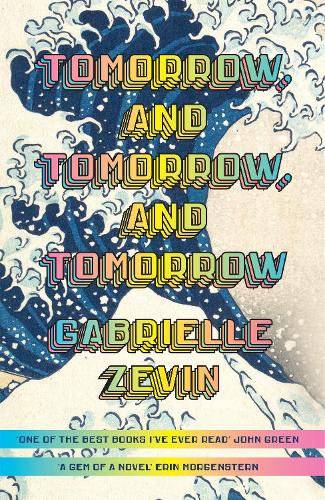
Book Review: Tomorrow and Tomorrow and Tomorrow by Gabrielle Zevin
‘Tomorrow and Tomorrow and Tomorrow’ by Gabrielle Zevin was published in 2022. It was well-praised by reviewers and Amazon named it as the best book of 2022.
It is a rich, immersive story that explores the relationship of Sadie Green and Sam Mazer throughout their lives, from their first encounter to their adult lives. Bonded by their love of video games, catastrophic events in their lives force them to build bridges, betray each other’s trust and move to and from each other like the tides.
I loved how Zevin navigates the themes in her novel, particularly in how she explores the idea of disability and chronic pain. How Sam navigates the world as a young, disabled person at Harvard. Harvard as an institution that is prided in its aesthetics, cobbled walkways, long pathways, and stairs make up the architecture of the buildings and despite their beauty, their timelessness, and their history, cobbled walkways are not equitably accessible to disabled people. Depending on their mobility aids, and access needs, they can be completely out of the question. At the start of the book, Sam walks with a limp, and later a cane, struggling with the slippery walkways in Massachusetts. However, there are other elements of his disability and pain that Zevin explores, such as how temperature can aggravate his foot, which has several metal rods in it, and later how he adjusts to his life as an amputee. Sam is disabled, but he is more than his disability and the trauma he endured as a result of it. I empathised with him, and his pain. He experiences phantom pain, self-medicates with recreational drugs, and is surprised when he gets older, and more confident walking on his prosthetic leg, that he isn’t immediately regarded as a disabled person, able to pass as an able-bodied man, and how surprised he was at that.
Zevin does not shy away from hard-hitting topics in her book, and for that, I am grateful. She delves into the idea of manipulation, abuse of power, women in technology, and the realities of sexual relationships, and body confidence.
Zoe, a supporting character in the novel is incredibly confident in her body, and always has been. She is described to have, even as a young teenager, having practiced using musical instruments naked, declaring her “first sexual experience was with her cello” and that her mother had been so disturbed by her daughter’s naked musicality, that she was sent to therapy. However, it isn’t Zoe who struck me the most with her brazen, and open nature with her body. No, though I loved about the moments is how when her partner encounters her, naked, in front of whatever instrument she was playing, in order to immerse herself in the sound and vibrations, and does not regard this as an invitation for sex. No, it’s just Zoe. It simply offers an echo of the idea that nudity isn’t consent.
In contrast, body image and confidence is echoed with Sam’s sexuality, and his encounters pre and post-amputation with the same partner, Lola, ears apart. I loved how this theme wasn’t exclusively relating to women’s sexuality, and that Sam isn’t stigmatised or regarded as devoid of sexual desire. Although, prior to sleeping with Lola the second time, he finds himself preferring masturbation. I really loved that Lola empowers Sam, and after they’re together again, he grows more confident despite having lost his leg. Zevin explores the idea of disability and how, prior to his amputation, Sam didn’t explicitly identify with the idea of being disabled, his disability was just “that thing with [his] foot” and I found this compelling and incredibly realistic. Denying, or a lack of acknowledgment of one’s disability is something I have encountered among circles of young, disabled people, because like Sam, they associate amputations and thus disability with army veterans. Seeing him grow into his persona, experience less-harrowing spells of phantom limb pain and whatnot was fantastic. I felt like a spectator, part of Sam’s circle and I wanted to celebrate with him as he overcame obstacles in his personal and professional lives.
I could scream my praise for Zevin’s work from the rooftops. Particularly in how she navigates the overarching metaphors of gaming and its power – in forging friendships that would last the tests of time, like Sam’s and Sadie’s, or romances and marriages like Simon and Ant’s. I loved how gaming and a love and passion for gaming offered perspective on age, and aging. Throughout the story, Sadie’s grandma, Freda, and Sam’s grandfather, Dong Hyun insist that their grandchildren have so much time and so much life left to live, and yet, as they progress in the games industry, they find themselves awed by how they went from being the youngest in the room to the oldest in what felt like the blink of an eye. Mortality and immortality, aging in an industry with speed and being replaced like debugging a game system. These metaphors were fantastic and I loved them. Furthermore, it provided a brilliant, and complimentary image to the way that Sam, Sadie and Marx in particular, hold classic literature and older works in high esteem. Marx’s love of the Iliad, and Shakespearian theatre are incredibly prominent in the story, and they contrast with the idea that games have to be constantly produced and distributed and sent into the world on a rolling basis for relevance. Crunching games, and forcing the developers to work unreasonable hours is an amazing contrast.
Then there’s the idea of love and found family. Sam and Sadie love each other. However, they are not romantically involved. They share a creative passion and a similar vision and have a partnership that transcends physical intimacy. Similarly, Marx and Sam have a kinship as young, Asian men in a horribly white institution like Harvard, they bonded over similar interests, and despite incredibly different backgrounds, Marx coming from a wealthy background, and Sam’s life being overarched by crushing debts from prolonged hospital stays and student loans, they share a keen love of gaming. Just like Sam and Sadie did. They’re brothers. Then there was the dynamic between Sadie and Marx, who bonded over gaming, and game design, Sadie designed games at MIT and Marx ended up playing them, loving them, and wanting her and Sam to succeed. What starts as a friend helping a friend ends up being the foundation of a formidable gaming company and a strong, realistic, raw found family dynamic. I loved seeing the characters grow together, get older and learn more about their industry.
I loved this book. I cried reading it and the second I put the book down, I was on the phone with a friend, hounding her to borrow it from her local library and go through the same emotional rollercoaster I’d just gone through. I loved Zevin’s command of storytelling and metaphors to offer a bitter, raw, and evocative take on life and people. I loved every moment of it: as a casual fan of video games, an avid reader, particularly of adaptations of classics like Shakespeare, the Odyssey, the Iliad, the Medea, and other Greek Epics, this book ticked all the right boxes. It was fantastic, and I’d highly recommend it.
 Imogen L. Smiley